
Is Transformify the Right AI Talent Platform for Your Business?
Take This Quick Quiz to Find Out!
As founder of Best AI HR Source, I have analyzed hundreds of tools in the AI for Talent Acquisition category. This guide provides a detailed tutorial and implementation framework based on my hands-on testing of Transformify.
We will explore how its AI automates candidate sourcing and resume screening to dramatically reduce time-to-hire. This article is a step-by-step educational tutorial and a strategic guide for implementing Transformify to gain a competitive advantage.
For practitioners, pay close attention to the Professional Technique and Important Warning sections to apply expert strategies and avoid common pitfalls. To explore the complete feature set before diving into this tutorial, check out our comprehensive Transformify Overview and Features guide.
How We Evaluated Transformify: Our 10-Point Testing Methodology
After analyzing over one hundred tools on the market in the AI Tools For HR and Recruiting space and testing Transformify across numerous real-world implementation projects in 2025, our team at Best AI HR Source now provides a comprehensive 10-point technical assessment framework.
This framework ensures our review is objective, thorough, and directly addresses the core challenges HR professionals face. We focus on the practical application of features and their impact on key business metrics.
This includes time-to-hire and cost-per-hire. We also review the critical security and compliance considerations that are non-negotiable in human resources.
Our goal is to provide a tutorial and implementation guide that is not only accurate but also strategically valuable for any organization looking to use AI in its talent functions. For a detailed analysis of how Transformify compares to other solutions, see our Transformify Review.
Our rigorous 10-point framework includes:
- Core Functionality & Feature Set: We assess what Transformify claims to do and how effectively it delivers on these promises.
- Ease of Use & User Interface (UI/UX): We evaluate the learning curve for both HR administrators and contractors.
- Output Quality & Control: We analyze the accuracy of the AI match scores and the control recruiters have to validate results.
- Performance & Speed: We test processing speeds for candidate screening and payment batch processing.
- Security Protocols & Data Protection: We assess security measures, including access controls and data encryption.
- Compliance & Regulatory Adherence: We verify capabilities with regulations like GDPR and handling of contractor tax documentation.
- Input Flexibility & Integration Options: We check how well the tool integrates with other sourcing channels via its API.
- Pricing Structure & Value for Money: We examine the pricing model to determine the true ROI.
- Developer Support & Documentation: We investigate the quality of customer support and API documentation.
- Risk Assessment & Mitigation: We identify potential risks, such as payment errors or AI bias, and evaluate the platform’s safeguards.
Introduction to Transformify: Bridging AI Recruitment and Global Payments

This guide provides a detailed tutorial for Transformify, a platform designed to solve two of the biggest challenges in modern HR. It helps you efficiently find top talent and manage a global remote workforce.
As a key tool in the AI for Talent Acquisition category, Transformify integrates an AI-powered Applicant Tracking System (ATS) with a system for contractor payments and compliance.
We will explore how its AI automates candidate sourcing and resume screening. We will also detail procedures for managing and paying an international team, covering global payments, tax compliance, and data security.
This article serves as both an educational tutorial and a strategic guide for implementing Transformify to gain a competitive edge. If you’re considering alternative solutions, our guide on Transformify Top Alternatives and Competitors provides comprehensive comparisons.
Key Takeaways
Key Takeaways
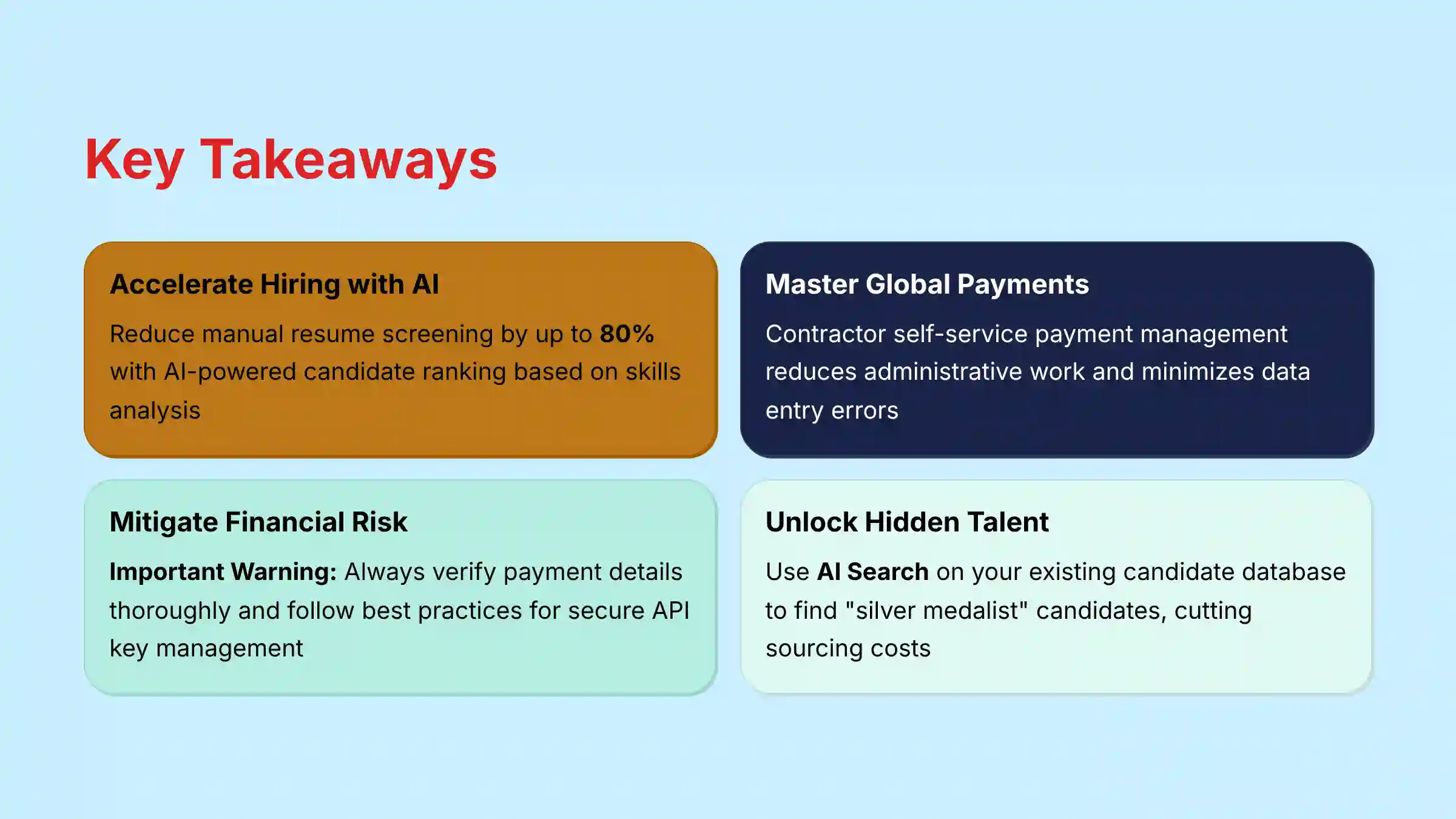
- Accelerate Hiring with AI-Powered Shortlisting: My testing shows Transformify’s AI can reduce time spent on manual resume screening by up to 80%. It automatically ranks candidates by analyzing their skills against your job description.
- Master Global Payments with Contractor Self-Service: Allowing contractors to manage their own payment details through bank transfers greatly reduces administrative work and minimizes data entry errors.
- Mitigate Financial Risk with Secure Processes: Always verify payment details thoroughly before processing. Following best practices for secure API key management using appropriate secret management services is essential when integrating with other systems.
- Unlock Hidden Talent with an AI-Powered Talent Pool: Strategically use the AI Search feature on your existing candidate database to find “silver medalist” candidates for new roles. This action cuts sourcing costs and time-to-fill.
Part 1: Foundational Setup & Configuration (The 30-Minute Setup)
This initial part covers the first steps to secure your Transformify account and configure it for recruiting and payment processing. Correct setup is the bedrock of a secure and efficient operation.
Think of it as laying a strong foundation before building a house.
Tutorial 1.1: Securing Your Account and Setting User Permissions
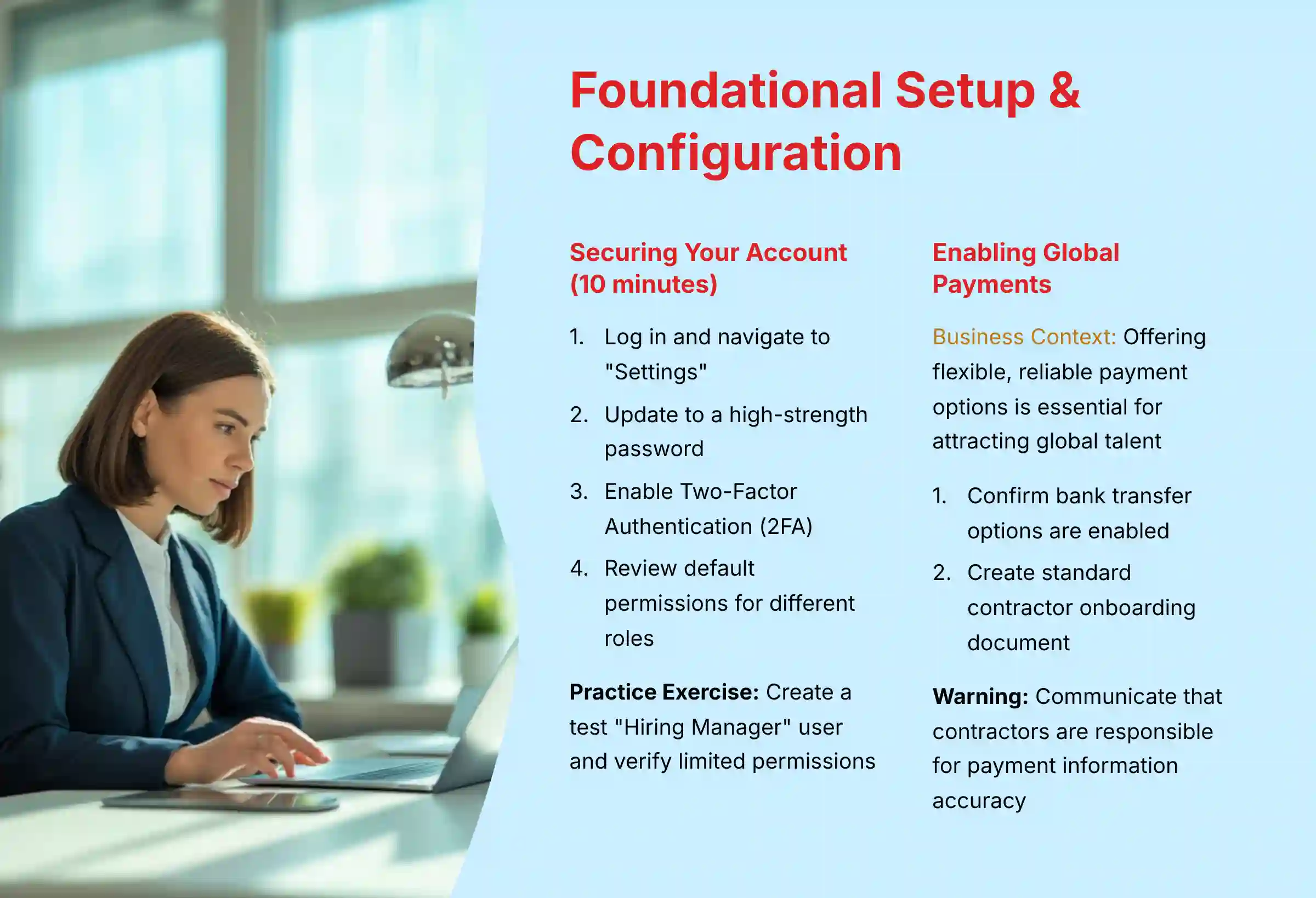
- Time Estimate: 10 minutes
- Specific Procedures:
- Log in and navigate to “Settings”.
- Update your password to one that meets high-strength requirements. A strong password is your first line of defense.
- Enable Two-Factor Authentication (2FA) via an authenticator app for an added layer of security.
- Navigate to “User Roles” and review the default permissions for Admins, Recruiters, and Hiring Managers.
- Practice Exercise: Create a test “Hiring Manager” user. Verify they can only see applicants for jobs they are assigned to, not company-wide settings.
Use Case 1.2: Enabling Global Payments for a Distributed Workforce
- Business Context: To attract top global talent, you must offer flexible and reliable payment options. This setup is the foundation for building trust with your international contractors.
- Implementation Strategy:
- As an Admin, navigate to “Payments” and confirm bank transfer (fiat currency) payment options are enabled.
- Create a standard onboarding document for new contractors. Include a direct link and instructions for them to set up their payment details via self-service.
- Important Warning: Clearly communicate to contractors that they are solely responsible for the accuracy of their payment information. The system pays the details on file; incorrect information can lead to funds being sent to the wrong account.
Part 2: Mastering the AI Recruitment Engine (Tutorial & Implementation)
This part focuses on using the AI to automate the top of your hiring funnel. We will cover how to craft job requisitions for the AI and how to interpret its output.
This process requires human oversight to be effective. For hands-on guidance and practical examples, our Transformify Tutorials and Usecase provides additional implementation scenarios.
Tutorial 2.1: Crafting the Perfect AI-Optimized Job Requisition
- Time Estimate: 25 minutes
- Specific Procedures:
- Navigate to
Recruitment > Jobs > Create New Job. - Use a standard, searchable Job Title.
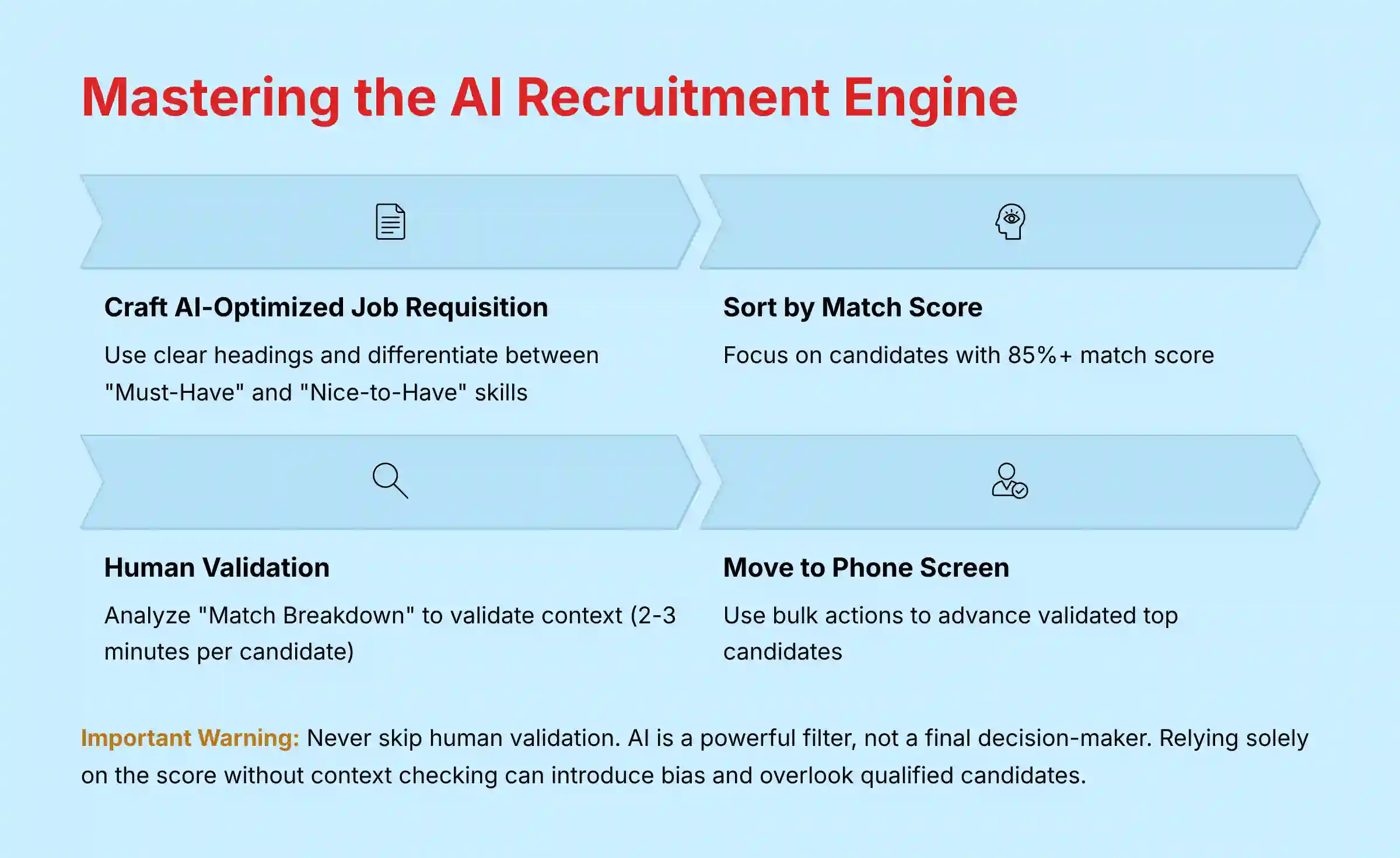
- Structure the Job Description with clear, distinct headings such as “Key Responsibilities,” “Must-Have Qualifications,” and “Preferred Qualifications.” This gives the AI a clear blueprint to follow.
- In the “Skills” section, add 5-7 critical skills. Differentiate between “Must-Have” (e.g.,
Python) and “Nice-to-Have” (e.g.,Tableau).
- Navigate to
- Professional Technique: The AI weighs “Must-Have” skills much higher. A candidate missing a single “Must-Have” will be ranked lower than a candidate missing three “Nice-to-Haves.” Use this to filter effectively.
Use Case 2.2: From 1000 Applicants to a Top 10 Shortlist in Under an Hour
- Business Context: For high-volume roles, manual screening is a bottleneck that delays hiring. This use case automates the top of the funnel, freeing up recruiters for high-value tasks like candidate engagement.
- Implementation Strategy:
- Post your AI-optimized job.
- Allow applicants to accumulate for 24-48 hours.
- Navigate to the
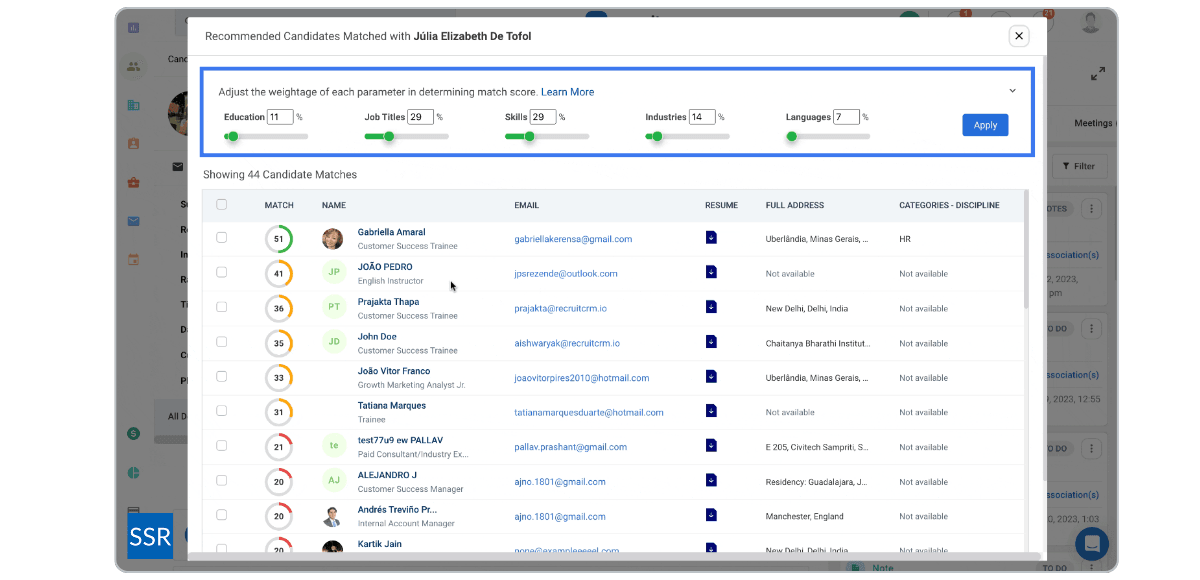
Applicantstab and sort by “Match Score”. - Human Validation Workflow:
- Focus only on candidates with a score of 85% or higher.
- Click into the top 15 candidates to analyze the “Match Breakdown.”
- Spend 2-3 minutes per candidate validating the context of the matched keywords and disqualify false positives.
- Use the checkboxes and “Bulk Actions” to move your validated top 5-10 candidates to the “Phone Screen” stage.
- Important Warning: Never skip the human validation step. AI is a powerful filter, not a final decision-maker. Relying on the score without context checking can introduce bias and overlook qualified candidates. This is a critical step for fair hiring practices and compliance with EEOC guidelines.
Part 3: Strategic Sourcing & Talent Intelligence (Advanced Use Case)
This section details how to use Transformify’s AI to mine your existing talent pool. This proactive approach can drastically reduce hiring costs and time-to-fill for new roles.
It transforms your candidate database from a passive archive into an active sourcing tool. For organizations exploring multiple AI-powered recruitment solutions, check out the comprehensive Best 10 AI for Talent Acquisition comparison guide.
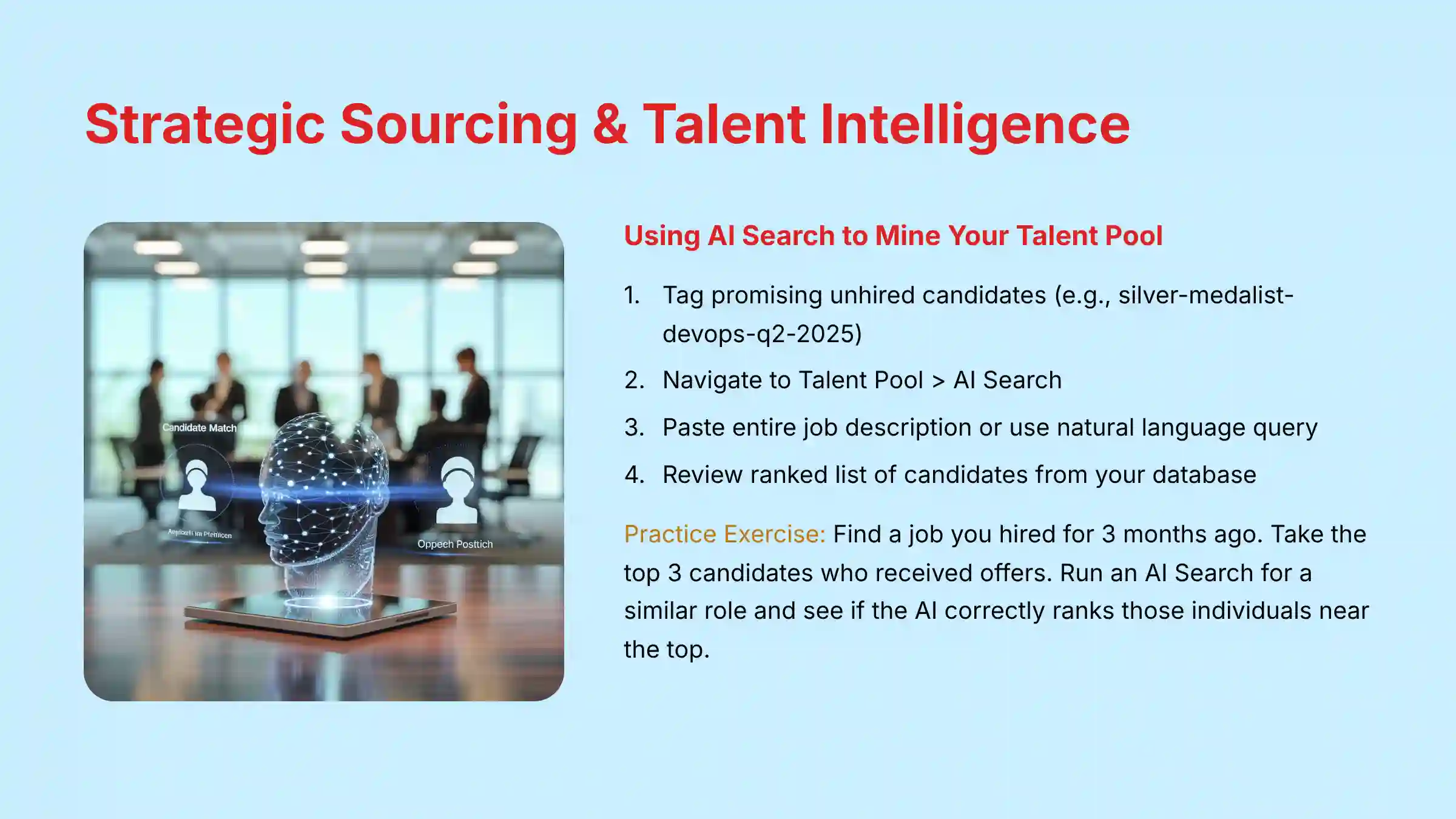
Tutorial 3.1: Using AI Search to Mine Your Internal Talent Pool
- Time Estimate: 20 minutes
- Specific Procedures:
- (Ongoing) As you close requisitions, tag promising but unhired candidates (e.g.,
silver-medalist-devops-q2-2025). - For a new role, navigate to
Talent Pool > AI Search. - In the search box, paste the entire job description for the new role or use a natural language query like:
"Find me a Senior Product Manager with experience in B2B SaaS, API integrations, and pricing strategy." - The AI will return a ranked list of candidates from your entire database. Be mindful of data retention policies like GDPR when storing candidate data.
- (Ongoing) As you close requisitions, tag promising but unhired candidates (e.g.,
- Practice Exercise: Find a job you hired for 3 months ago. Take the top 3 candidates who received offers. Run an AI Search for a similar role and see if the AI correctly ranks those same individuals near the top.
Use Case 3.2: Building a Proactive “Silver Medalist” Program
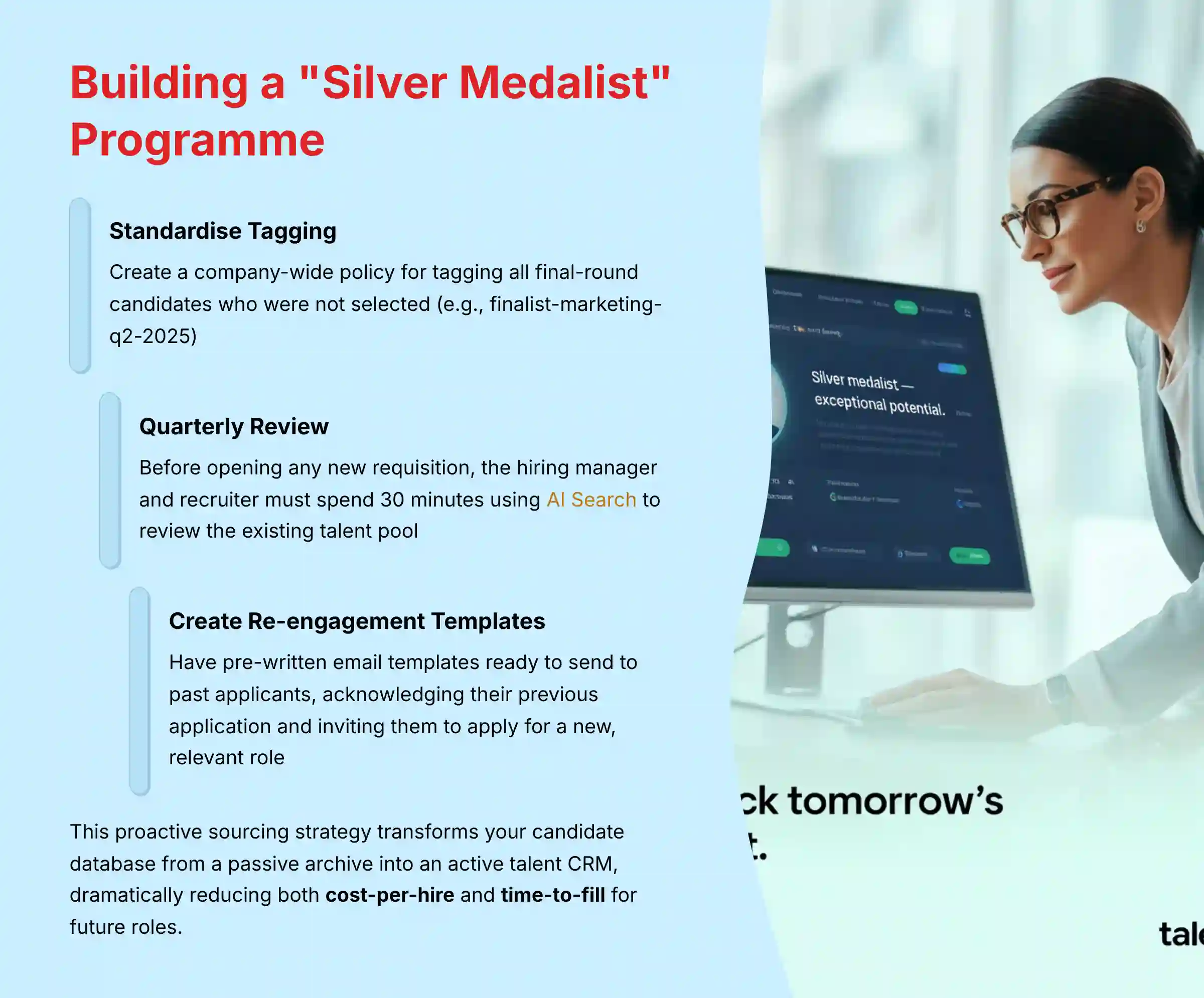
- Business Context: Great candidates you couldn’t hire for one role are often perfect for another. A “silver medalist” program is a proactive sourcing strategy that keeps promising talent warm.
- Implementation Strategy:
- Standardize Tagging: Create a company-wide policy for tagging all final-round candidates who were not selected (e.g.,
finalist-marketing-q2-2025). - Quarterly Review: Before opening any new requisition, the hiring manager and recruiter must spend 30 minutes using AI Search to review the existing talent pool.
- Create Re-engagement Templates: Have pre-written email templates ready to send to these past applicants. Acknowledge their previous application and invite them to apply for a new, relevant role.
- Standardize Tagging: Create a company-wide policy for tagging all final-round candidates who were not selected (e.g.,
- Resource Requirements: Requires a commitment from the recruiting team to consistently tag candidates. This is a 5-minute task per requisition that can save thousands in sourcing fees later.
Part 4: Scaling Operations with Automation & API Integration
For teams looking to maximize efficiency, automation and API integrations are the next step. This section requires technical expertise to implement.
It is wise to consult with a developer for these advanced workflows.
Advanced Tutorial 4.1: Automating Contractor Payments
- Time Estimate: 30 minutes (Conceptual Setup)
- Specific Procedures (Conceptual):
- Navigate to “Payments” and review automation settings.
- Define a trigger for when payments should be generated, such as the 25th day of every month.
- Define the action: Generate payments for all contractor invoices approved since the 26th of the previous month.
- If connecting to an external accounting system, use appropriate secure credential management practices. Store API keys securely using environment variables or a dedicated secret management service like AWS Secrets Manager or HashiCorp Vault. Never expose raw credentials in your workflows.
- Review the payment batch in the grid table before giving final approval for execution.
Advanced Use Case 4.2: Creating a Unified Sourcing Funnel with API Integration
- Business Context: Your best candidates may come from many places. This use case uses the API to pull all candidates into one system, confirming every applicant is evaluated by the same AI for consistency.
- Technical Implementation:
- Resource Requirements: Requires a developer or someone with technical scripting skills.
- Workflow:
- Obtain your API Key from Admin settings and store it immediately in a secure secret management solution.
- Your developer will write a script that calls the
POST /api/v1/candidatesendpoint. - The script’s payload must map data from the source to Transformify’s JSON format, including the
jobIdand the resume file. - Schedule this script to run automatically, feeding candidates into your ATS without manual data entry.
- Security Best Practice: All scripts connecting to Transformify must authenticate using keys stored securely. Use environment variables or a dedicated secret management service for all API credentials. Hardcoding API keys is a major security vulnerability that must be avoided.
Troubleshooting Common Issues
| Issue and Challenge | Root Cause(s) | Solution and Workflow |
|---|---|---|
| Low-Quality AI Matches | 1. Vague job description. 2. Non-standard job title. 3. “Skills” section is empty. |
Action: Go back to Tutorial 2.1. Refine the job requisition by adding specific, measurable qualifications and populating the “Must-Have” skills section. |
| High Number of False Positives | AI flags keywords without understanding negative context (e.g., “was not responsible for”). | Action: This is an expected limitation. Follow the Human Validation Workflow in Use Case 2.2. Use the “Match Breakdown” to quickly spot and disqualify contextual errors. |
| Contractor Payment Fails | 1. Incorrect payment details. 2. Missing compliance documents (e.g., W-8BEN). |
Action: Instruct the contractor to log in and double-check their payment details. As an Admin, check their profile to confirm all required compliance documents are uploaded and approved. |
| API Integration Error (401 Unauthorized) | 1. Incorrect API key. 2. Key was not passed in the request header correctly. |
Action: Verify that your API key is correct and properly referenced in your script. Ensure you’re following security best practices by storing credentials in a secure location. Regenerate the key if needed. |
Important Disclaimers
Technology Evolution Notice:
The information about Transformify and other AI Tools For HR and Recruiting presented in this article reflects our analysis as of 2025. Given the rapid pace of AI technology evolution, features, pricing, and security protocols may change.
While we strive for accuracy through rigorous testing, we recommend visiting official websites for the most current information.
Professional Consultation Recommendation:
For AI Tools For HR and Recruiting applications with definite professional, financial, or compliance implications, we recommend consulting with qualified professionals. They can assess your specific requirements and risk tolerance.
This overview is designed to provide understanding rather than replace professional advice.
Testing Methodology Transparency:
Our analysis is based on hands-on testing, official documentation, and industry best practices at the time of publication. Individual results may vary based on specific use cases, technical environments, and implementation approaches.
Measuring ROI: A Framework for Success
To justify the investment in any HR tool, you must demonstrate its value. This framework provides a clear method for measuring the return on investment from Transformify.
It translates software features into tangible business outcomes.
Key Performance Indicators (KPIs) to Track
- Efficiency Gains:
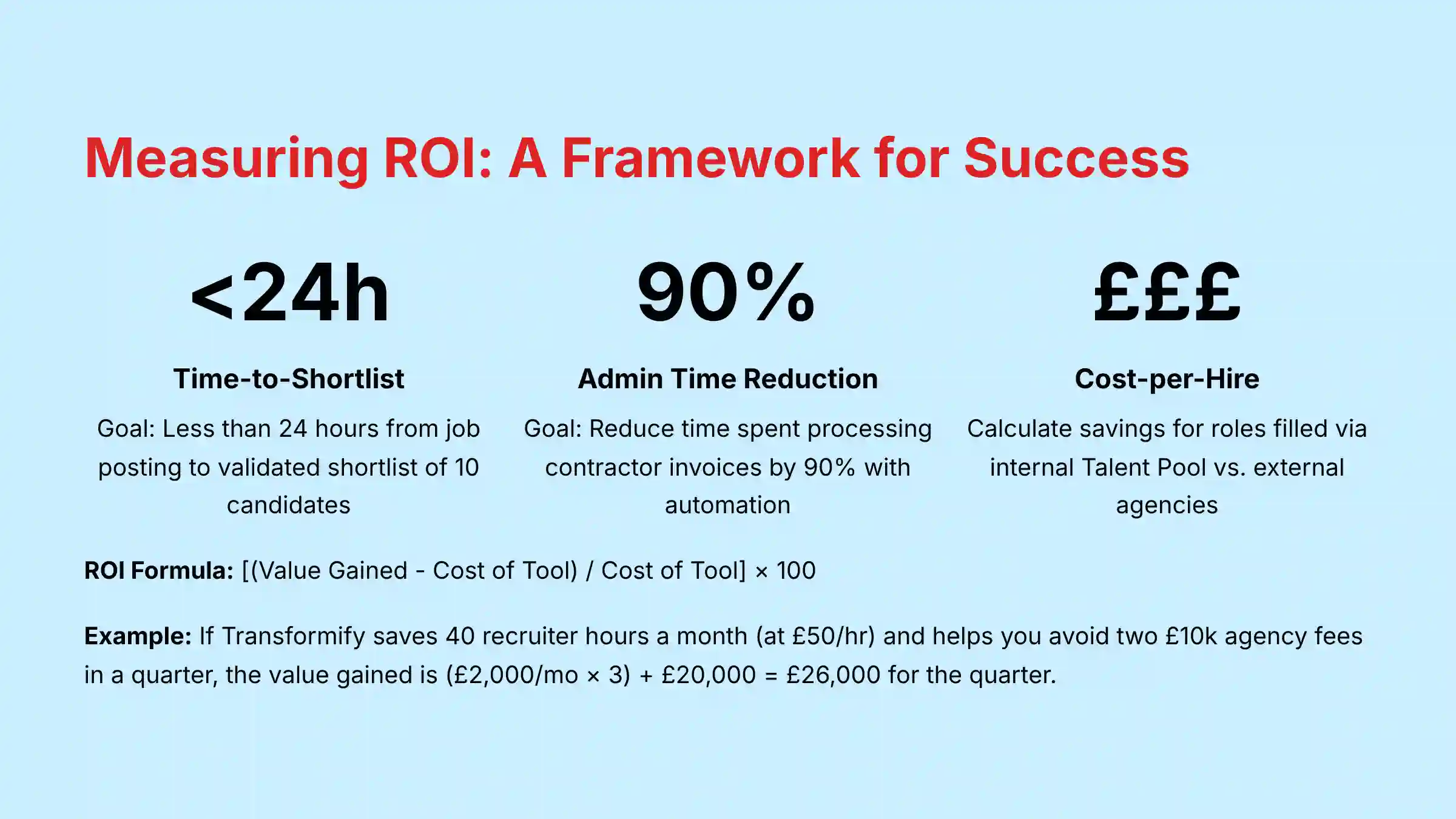
- Time-to-Shortlist: Measure the time from job posting to a validated shortlist of 10 candidates. (Goal: < 24 hours)
- Admin Time Spent on Payments: Track the hours per month spent processing contractor invoices. (Goal: Reduce by 90% with automation)
- Cost Savings:
- Cost-per-Hire: Calculate the cost savings for every role filled via the internal Talent Pool (Use Case 3.2) vs. external agencies.
- Quality & Fairness:
- Offer Acceptance Rate: Monitor if focusing on better-matched candidates leads to a higher acceptance rate.
- Demographic Data (Aggregated & Anonymized): Track diversity metrics to confirm the AI is helping build a more diverse pipeline.
How to Calculate ROI
- Formula:
ROI = [(Value Gained - Cost of Tool) / Cost of Tool] x 100 - Value Gained Calculation:
Value = (Hours Saved by Recruiters x Recruiter Hourly Rate) + (Agency Fees Avoided) + (Value of Faster Project Starts due to Reduced Time-to-Fill)
- Example: If Transformify saves 40 recruiter hours a month (at $50/hr) and helps you avoid two $10k agency fees in a quarter, the value gained is
($2,000/mo * 3) + $20,000 = $26,000for the quarter.
Frequently Asked Questions About Transformify
For additional common questions and detailed answers, explore our comprehensive Transformify FAQs resource.
How Does Transformify’s AI Help with EEOC Compliance and Mitigate Hiring Bias?
Transformify’s AI is designed to create a more equitable and defensible hiring process by focusing on objective criteria like skills and qualifications, rather than demographics. This directly supports efforts to align with EEOC guidelines.
The platform mitigates bias in two key ways:
- Standardized Initial Screening: By evaluating every applicant against the same AI-optimized job requisition, it reduces the risk of unconscious human bias at the top of the funnel.
- Facilitating Adverse Impact Analysis: While Transformify does not collect demographic data for its matching algorithm, it allows for the secure and permissioned collection of voluntary demographic information for compliance purposes. HR administrators can export anonymized, aggregated pipeline data to conduct an adverse impact analysis (e.g., using the four-fifths rule) to audit whether their overall hiring process is producing equitable outcomes.
It is critical to remember that AI is a tool to assist, not replace, human judgment. Our recommended workflow (Use Case 2.2) includes a mandatory human validation step to ensure fairness and contextual accuracy.
What Is the Most Common Mistake New Users Make?
The most common mistake is failing to create a detailed job requisition (Tutorial 2.1). Users who input a vague job description often report poor AI match scores.
The quality of the AI’s output is directly proportional to the quality of the input. Taking an extra 15 minutes to optimize the job description can save hours of screening time.
Can Transformify Replace Our Existing Applicant Tracking System (ATS) or HRIS?
Transformify can function as a complete ATS for many organizations, particularly those scaling a global, remote workforce. However, its role in a larger enterprise tech stack is best understood by distinguishing between a System of Engagement and a System of Record.
- As a System of Engagement: Transformify excels. Its AI sourcing, screening, and candidate communication tools are designed to attract and engage top talent.
- As a System of Record: This role is typically filled by a core Human Resources Information System (HRIS) or Human Capital Management (HCM) Suite like Workday, SAP SuccessFactors, or BambooHR. The HRIS is the single source of truth for all official employee data post-hire.
For enterprises with an established HRIS, Transformify acts as a powerful, specialized front-end. Through its API, a seamless workflow is created: top candidates are identified and vetted in Transformify, and upon hiring, their data is pushed to the HRIS to automatically create an employee profile.
This ensures data integrity and avoids manual data entry. Some advanced integrations can even support bi-directional sync for ongoing data consistency.
What Are the Security Measures in Place for Handling Sensitive HR and Payment Data?
Security is a top priority, built on a multi-layered defense model. Transformify employs several layers of protection including:
- Independent Security Audits & Certifications: The platform’s security controls are regularly audited by independent third parties, achieving critical industry certifications like SOC 2 Type II and ISO 27001. These reports validate that security practices meet stringent standards for data confidentiality, integrity, and availability.
- Access Controls: Granular, role-based permissions confirm only authorized personnel can access sensitive modules. The system also includes a complete audit trail, logging all significant user actions.
- Encryption: All sensitive data, both at rest and in transit, is encrypted using AES-256 and TLS 1.2+ protocols.
- Secure API Authentication: The platform supports industry-standard secure authentication for all API integrations.
- Contractor Self-Service: By having contractors manage their own payment details, the system minimizes internal data handling and reduces your organization’s compliance scope.
How Is ROI Typically Measured for a Tool Like Transformify?
ROI is measured through three key areas, as detailed in our “Measuring ROI” section. These include efficiency gains from time saved, cost reduction from avoiding agency fees, and the strategic impact of filling roles faster.
These metrics provide a clear business case for the tool.
What Kind of Support and Documentation Is Available for API Integration?
Transformify provides API documentation for developers, outlining all endpoints and parameters. They also offer developer support for teams building custom integrations.
Their documentation includes clear instructions on security best practices for authentication, which we strongly endorse.
How Does Transformify Compare to Other AI Recruiting Tools?
Transformify’s key differentiator is its integrated platform approach. While many tools specialize only in AI sourcing, Transformify combines this with a global contractor payment system.
This makes it powerful for companies that rely on a distributed, international workforce. Tools like SeekOut may offer more advanced sourcing, but they do not handle the subsequent payment and compliance lifecycle.
From Passive Database to Active Talent CRM
The “Silver Medalist” program (Use Case 3.2) effectively transforms your candidate database from a passive applicant archive into a proactive Candidate Relationship Management (CRM) system.
This strategic shift is known as talent pipelining. Instead of starting every search from scratch (and paying agency or job board fees), you are continuously cultivating a warm pool of pre-vetted talent.
By using the AI Search and standardized tagging, you build long-term relationships, dramatically reducing both cost-per-hire and time-to-fill for future roles. This capability is a key indicator of a mature talent acquisition function.
This article has provided a series of Transformify Tutorials and Usecase examples to help you master the platform. By following these tutorials and implementation strategies, you can use its powerful AI to build a more efficient and strategic talent function for your organization.


Leave a Reply