Is Zoho People the Right HR Platform for Your Business?
Take Our 2-Minute Quiz to Find Out!
Zoho People stands as one of the most comprehensive cloud-based HR management solutions available today, transforming how modern organizations handle their human resource operations. This extensive FAQ guide covers everything you need to know about Zoho People’s AI-powered capabilities, integration options, pricing structure, and implementation process.
Key Takeaways
- Comprehensive HRMS Solution: Zoho People serves as a centralized platform managing the complete employee lifecycle from onboarding to offboarding
- AI-Powered Automation: Zia AI assistant automates routine HR tasks, provides sentiment analysis, and delivers 24/7 employee support
- Seamless Ecosystem Integration: Native integration with Zoho CRM, Books, Recruit, and other business applications creates a unified operating system
- Transparent Pricing Structure: Competitive pricing starting at $1.50 per user/month with no hidden costs and comprehensive feature sets
- Enterprise-Grade Security: SOC 2 Type II and ISO 27001 certified with comprehensive GDPR compliance and advanced data protection measures
Whether you’re evaluating Zoho People against competitors like BambooHR, planning implementation, or seeking to understand its advanced AI capabilities, this guide provides detailed insights to support your decision-making process. For additional information about Zoho People Overview and Features, explore our comprehensive platform analysis.
What is Zoho People and how does it transform HR operations for modern businesses?
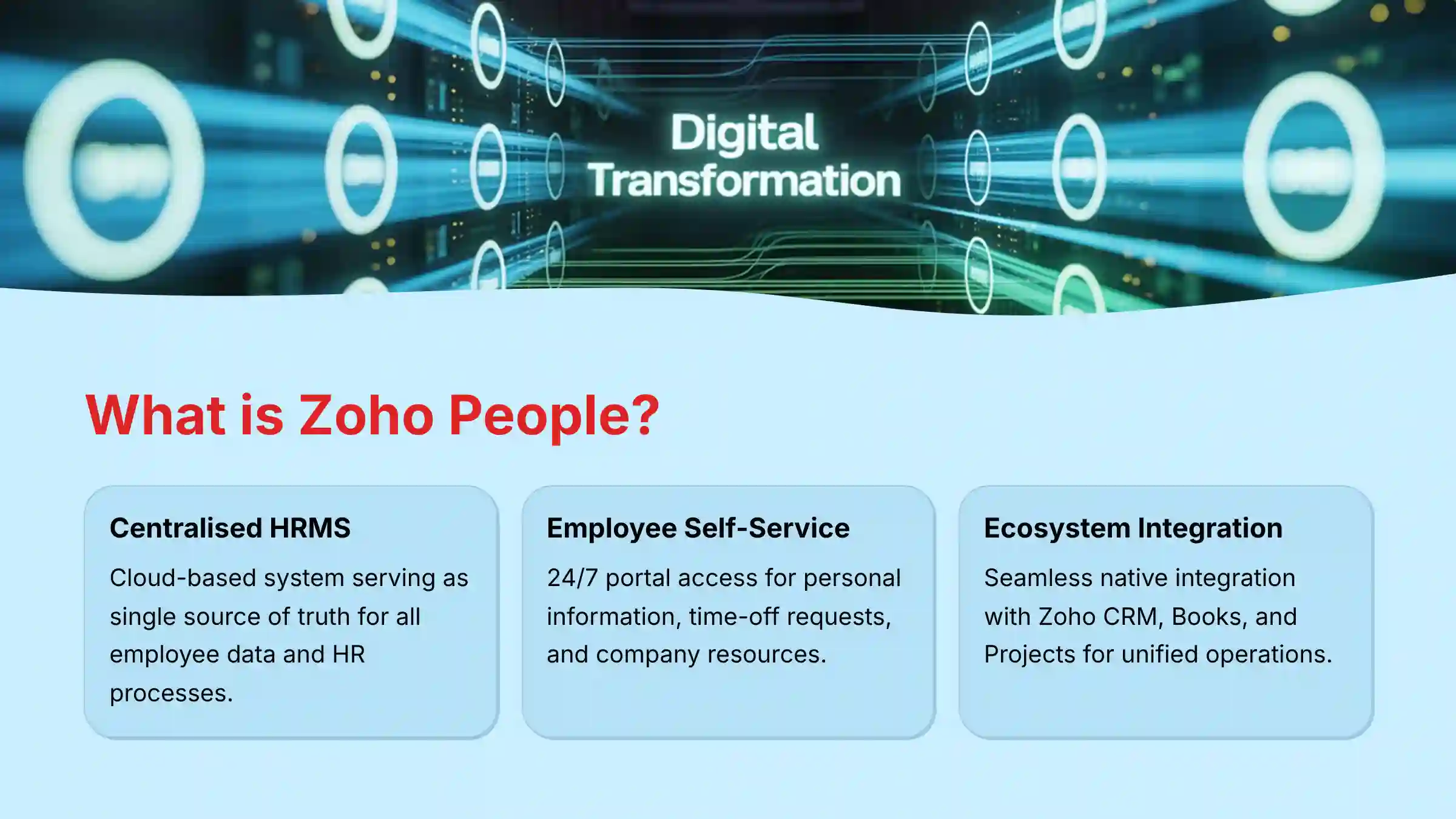
Zoho People is a comprehensive cloud-based Human Resource Management System (HRMS) designed to digitize and automate core HR operations for organizations of all sizes. Rather than relying on scattered spreadsheets and manual paperwork, Zoho People serves as a centralized “single source of truth” for all employee data and HR processes.
The platform transforms traditional HR operations by moving beyond administrative tasks to become a strategic business partner. For HR administrators, it automates the entire employee lifecycle from recruitment handoff and onboarding through performance management, attendance tracking, and offboarding. The system eliminates time-consuming manual data entry and reduces the risk of human error in critical HR processes.
For employees, Zoho People provides an intuitive self-service portal where they can access personal information, submit time-off requests, view payslips, update personal details, and interact with company resources without requiring HR intervention. This self-service approach significantly reduces the administrative burden on HR teams while improving employee satisfaction through 24/7 access to their information.
The platform is particularly powerful for organizations already using or considering the broader Zoho ecosystem, including Zoho CRM, Zoho Books, or Zoho Projects, as it offers seamless native integration across the entire business operating system. Companies seeking to modernize their HR processes, improve operational efficiency, and provide enhanced employee experiences through automation will find Zoho People an ideal solution for their digital transformation journey.
How does Zoho People’s AI assistant Zia automate HR tasks and improve efficiency?
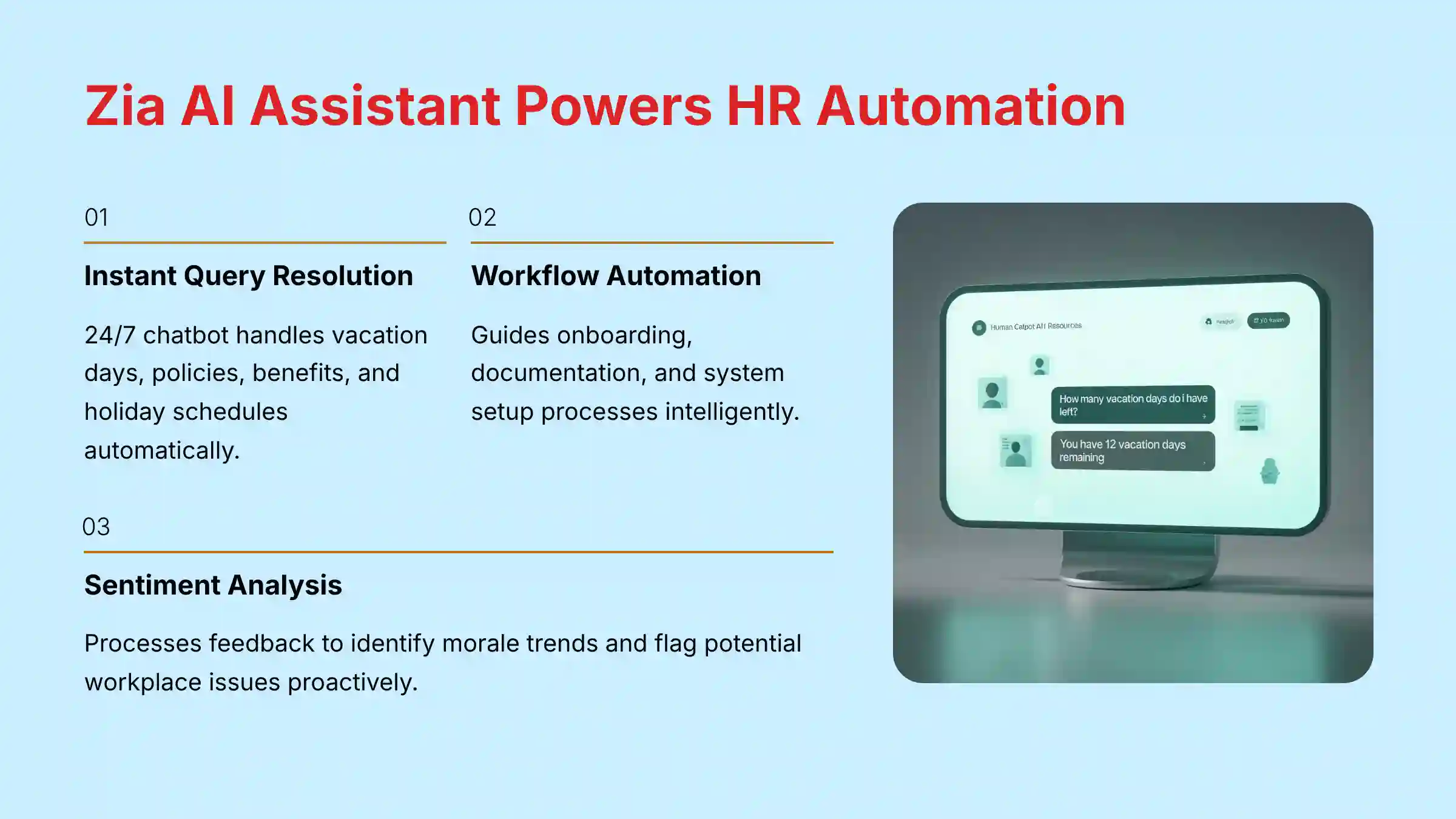
Zia, Zoho’s integrated AI assistant, functions as an intelligent automation layer within Zoho People, handling routine inquiries and processes that traditionally require direct HR intervention. Available starting with the Professional plan, Zia transforms HR operations by providing instant, accurate responses to common employee questions through an intelligent chatbot interface.
The AI assistant excels at handling high-volume, repetitive queries that consume significant HR time. Employees can interact with Zia to instantly access information such as remaining vacation days, company policy details, benefit information, or holiday schedules. This 24/7 availability ensures employees receive immediate answers without waiting for HR team availability, dramatically improving the employee experience while reducing HR workload.
Beyond simple queries, Zia automates complex workflows throughout the employee lifecycle. During onboarding, the AI guides new hires through required documentation, company policy acknowledgments, and system setup processes. For managers, Zia can provide insights into team attendance patterns, performance trends, and upcoming review deadlines.
One of Zia’s most advanced capabilities is sentiment analysis of employee feedback. The AI can process text from performance reviews, engagement surveys, and feedback forms to identify emotional trends, flag potential morale issues, and surface recurring themes that require management attention. This proactive approach enables HR teams to address workplace concerns before they escalate into larger problems, transforming HR from a reactive function into a strategic, data-driven operation focused on employee satisfaction and retention.
Organizations leveraging AI in talent acquisition will find valuable insights in our guide to Best 10 AI for Talent Acquisition tools and strategies.
What are the key differences between Zoho People and Zoho Recruit in the HR ecosystem?
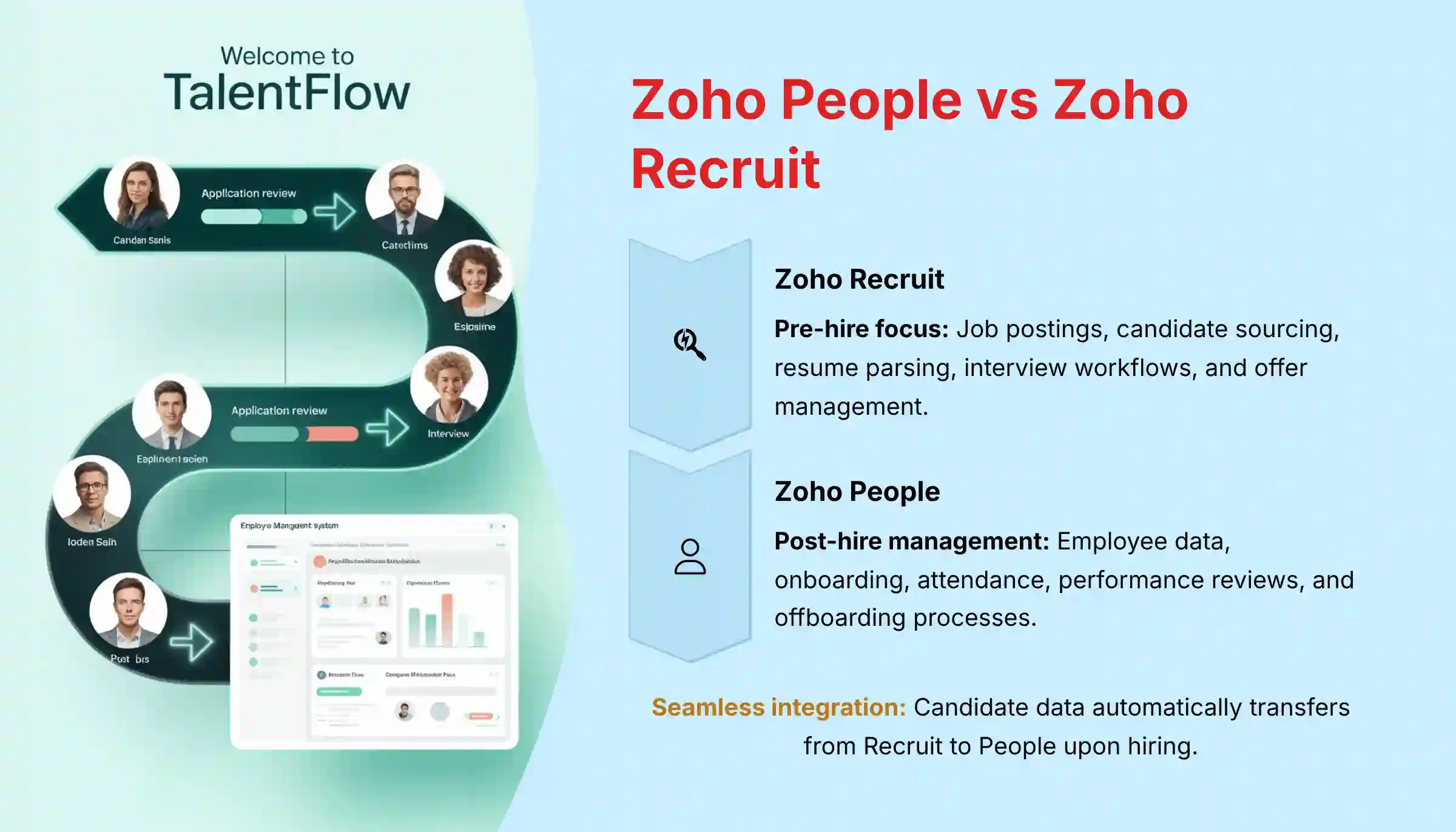
Understanding the distinction between Zoho People and Zoho Recruit is crucial for organizations building a comprehensive HR technology stack. These platforms serve complementary but distinct phases of the employee lifecycle, with Zoho Recruit handling pre-hire activities and Zoho People managing post-hire operations.
Zoho Recruit is a dedicated Applicant Tracking System (ATS) designed specifically for talent acquisition. It empowers recruiters and hiring managers to post job openings across multiple job boards, source candidates from various databases, parse and rank resumes using AI technology, manage complex interview workflows, and extend job offers. The platform includes features like candidate relationship management, interview scheduling automation, and recruiting analytics. Its primary mission is optimizing the efficiency and effectiveness of finding, evaluating, and hiring new talent.
Zoho People assumes responsibility once a candidate accepts an offer and becomes an employee. The platform manages comprehensive employee data, handles onboarding processes, tracks time and attendance, administers performance reviews, manages benefits enrollment, and processes offboarding procedures. Zoho People serves as the central system of record throughout an employee’s entire tenure with the organization.
The true power emerges when these platforms work together. A typical workflow begins with managing all recruiting activities in Zoho Recruit. Once a candidate accepts an offer, their information automatically transfers to Zoho People, creating their official employee profile without manual data entry. This seamless integration eliminates duplicate work, reduces errors, and ensures smooth transitions from candidate to employee.
While Zoho People includes basic case management features that could theoretically handle simple recruitment tracking, this approach creates significant administrative overhead and lacks the sophisticated functionality required for effective talent acquisition at scale. Organizations serious about both recruitment and employee management should leverage both platforms as an integrated solution.
For detailed tutorials on maximizing both platforms’ potential, explore our Zoho People Tutorials and Usecase guide.
How does Zoho People compare to BambooHR for small and medium businesses?
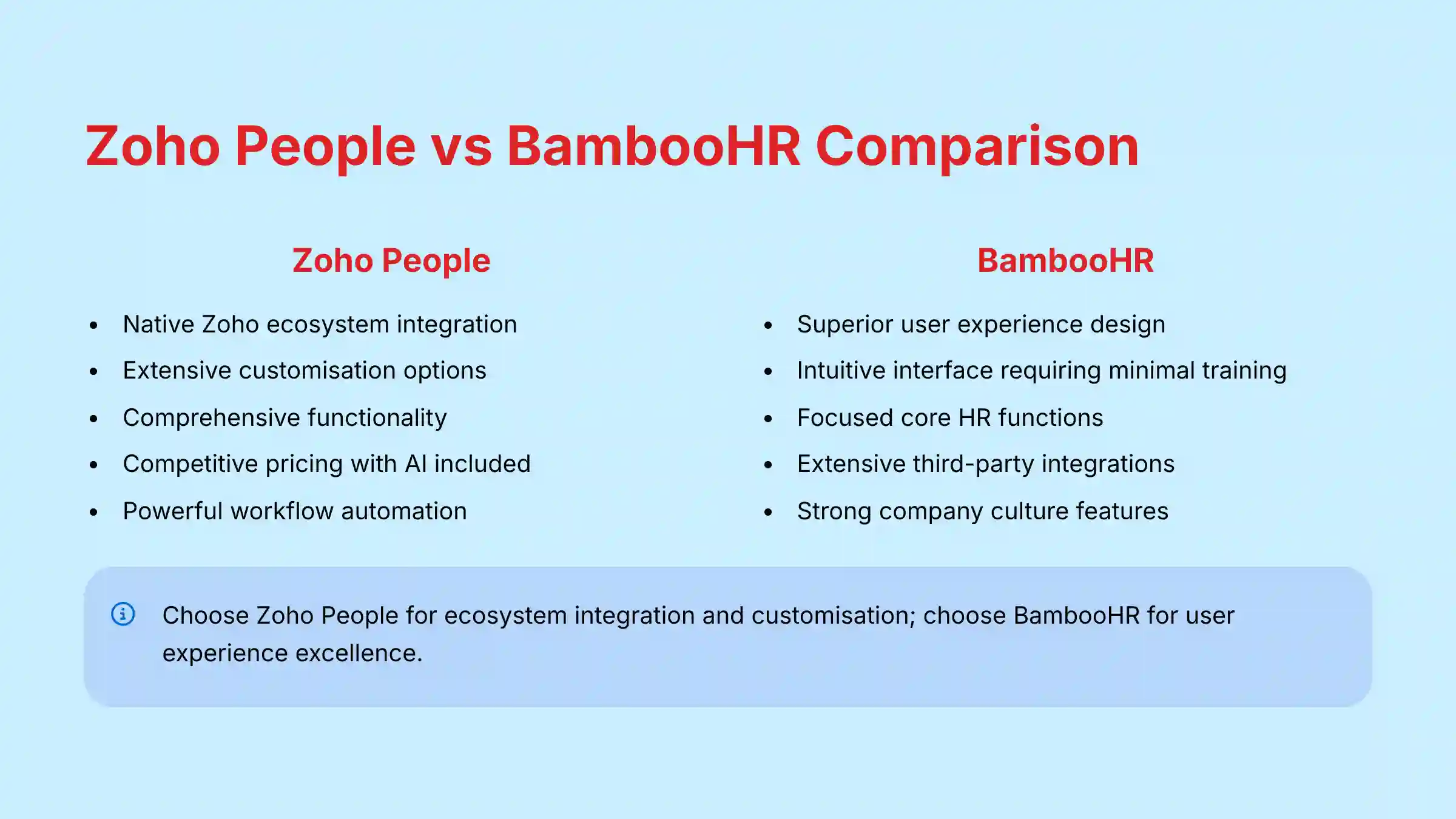
The choice between Zoho People and BambooHR often reflects different organizational priorities: ecosystem integration versus user experience excellence, and comprehensive functionality versus focused execution.
Zoho People’s greatest strength lies in its position within the expansive Zoho ecosystem. For organizations already using Zoho CRM, Zoho Books, or other Zoho applications, People provides seamless native integration that creates a unified business operating system. Data flows effortlessly between applications without complex API configurations or third-party integration tools. The platform offers remarkable breadth of functionality, extensive customization options, powerful workflow automation, and competitive pricing that often provides more features per dollar than alternatives. The AI assistant Zia is included at lower price points compared to similar AI features in competing platforms.
BambooHR excels in user experience design and interface simplicity. The platform is renowned for its clean, intuitive interface that requires minimal training for both HR administrators and employees. This superior usability often results in higher adoption rates and reduced support requirements. While BambooHR may not offer the extensive customization of Zoho People, the features it provides are exceptionally well-designed and implemented. The platform focuses on core HR functions with particular strength in performance management, employee satisfaction tracking, and company culture building.
Integration approaches differ significantly. Zoho People offers deep, native integration within its ecosystem but may require more configuration for external applications. BambooHR provides a robust, well-documented API with an extensive marketplace of third-party integrations, though these connections aren’t as seamless as Zoho’s native ecosystem integration.
Decision framework: Choose Zoho People if your organization is committed to the Zoho ecosystem, requires extensive customization capabilities, and prioritizes comprehensive functionality at competitive pricing. Choose BambooHR if user experience excellence is your primary concern, you prefer focused tools that execute core functions exceptionally well, and you need extensive third-party integration flexibility.
To explore additional options, review our comprehensive Zoho People Top Alternatives and Competitors analysis.
Can Zoho People’s AI analyze employee sentiment and what are the privacy considerations?

Zoho People’s AI assistant Zia includes sentiment analysis capabilities that can process qualitative employee feedback to identify emotional trends and workplace satisfaction patterns. This feature operates within the performance management and employee engagement modules, analyzing text from performance reviews, feedback surveys, engagement assessments, and other employee communications.
The AI processes open-ended comments and responses to classify sentiment as positive, negative, or neutral, then aggregates this data to provide HR leaders with organizational mood insights. This analysis can identify declining morale in specific departments, surface recurring workplace concerns, and highlight positive trends that should be reinforced. The system can detect patterns such as increased negative sentiment following policy changes or improved satisfaction after implementing new benefits.
However, AI-powered sentiment analysis raises significant privacy and trust considerations that require careful management. The primary risk is employee trust erosion if workers feel their communications are being monitored or analyzed without transparency. If employees believe their candid feedback could be used against them, they will stop providing honest input, rendering the entire system counterproductive.
Privacy best practices include:
Anonymity and aggregation: Sentiment analysis should focus on departmental or organizational trends rather than individual employee tracking. Reports should show patterns like “Engineering department sentiment decreased 15% this quarter” rather than identifying specific individuals.
Transparency and communication: Organizations must clearly communicate how sentiment analysis is used, emphasizing that the goal is improving overall workplace conditions and addressing systemic issues, not targeting individual employees.
Access controls: Configure role-based permissions to ensure only authorized HR personnel and senior leaders can access sentiment reports. Individual managers should not have access to detailed sentiment data about their direct reports.
Data governance: Establish clear policies about data retention, analysis scope, and decision-making processes based on sentiment insights.
When implemented transparently and ethically, sentiment analysis becomes a powerful tool for proactive HR management, enabling organizations to address workplace issues before they result in turnover or decreased productivity.
What is the detailed pricing structure for Zoho People and are there hidden costs?

Zoho People employs a transparent per-employee, per-month pricing model with annual billing typically offering significant discounts. As of 2024, the platform maintains competitive pricing across multiple tiers designed to accommodate organizations of various sizes and complexity requirements.
Current pricing structure:
Free Plan: Available permanently for organizations with up to 5 employees, providing basic employee database management, document storage, and time-off tracking functionality.
Essential HR Plan: Starting at $1.50 per user/month (annual billing), this entry-level paid tier includes core HRMS functions such as employee onboarding, document management, basic time and attendance tracking, and employee self-service portal access.
Professional Plan: $2 per user/month (annual billing) or $2.50 per user/month (monthly billing). This tier adds advanced features including shift scheduling, Zia AI assistant, integrations with other Zoho applications, and enhanced reporting capabilities.
Premium Plan: $3 per user/month (annual billing) or $3.50 per user/month (monthly billing). This popular tier includes performance management features, 360-degree feedback systems, advanced analytics dashboards, and comprehensive workflow automation.
Enterprise Plan: $5 per user/month (annual billing) or $6 per user/month (monthly billing). The comprehensive tier provides employee case management, advanced learning management system (LMS) features, custom app development capabilities, and premium support.
Hidden costs are minimal compared to many competitors. Zoho typically does not charge mandatory implementation fees for standard deployments. However, organizations with complex requirements may choose optional paid services including premium onboarding assistance, custom workflow development, or priority support packages.
Important considerations: Payroll processing and advanced recruiting capabilities (Zoho Recruit) are separate products with additional subscription costs. Organizations requiring comprehensive talent acquisition should budget for both platforms. Always verify current pricing for your specific region on the official Zoho People website before making purchasing decisions, as pricing and features may vary by market and are subject to change.
For an in-depth analysis of value and features, read our detailed Zoho People Review.
What data security and compliance measures does Zoho People provide for sensitive HR information?
Zoho People implements comprehensive data security and compliance measures designed to protect sensitive employee information and meet international regulatory requirements. Given that HR systems process highly confidential personal data including salaries, performance evaluations, health information, and personal details, security represents a non-negotiable foundation of the platform.
Compliance certifications form the cornerstone of Zoho’s security framework. The platform maintains SOC 2 Type II certification, which validates controls for security, availability, processing integrity, confidentiality, and privacy through independent auditing. ISO 27001 certification demonstrates commitment to international information security management standards. These certifications require ongoing compliance audits and continuous security improvement.
GDPR compliance is comprehensive, with built-in features to support European data protection requirements. The platform includes tools for managing data subject requests, including the right to access personal data and the right to be forgotten. Consent management features help organizations track and document lawful bases for data processing. Data processing activities are documented and auditable to demonstrate compliance with regulatory requirements.
Data encryption protects information both at rest and in transit using industry-standard protocols. All data stored on Zoho servers uses AES-256 encryption, while data transmission employs TLS encryption to prevent interception. Database encryption ensures that even physical access to servers cannot compromise employee data.
Access controls provide granular, role-based permissions enabling organizations to implement the principle of least privilege. Managers can be restricted to viewing only their direct reports’ information, while HR administrators have broader access based on their responsibilities. Multi-factor authentication adds additional security layers for administrative access.
Regional data residency options allow organizations to choose where their data is stored and processed, supporting compliance with local data sovereignty requirements. Regular security audits, vulnerability assessments, and penetration testing ensure ongoing protection against emerging threats.
These security measures are essential for maintaining employee trust and meeting legal obligations for data protection in HR operations.
What is the typical implementation timeline and process for Zoho People?

Zoho People implementation typically ranges from one to six weeks depending on organizational size, process complexity, and customization requirements. The structured implementation approach ensures systematic deployment while minimizing disruption to ongoing HR operations.
Phase 1: Foundation Setup (1-3 days)
Initial configuration establishes the organizational structure within Zoho People. This includes defining company locations, departments, job roles, and reporting hierarchies. Core policies such as working hours, holiday calendars, leave types, and attendance rules are configured during this phase. The foundation setup creates the framework for all subsequent HR processes.
Phase 2: Data Migration and Cleanup (2-7 days)
Employee data migration often represents the most time-intensive implementation phase. Existing information from spreadsheets, legacy systems, or other HR platforms must be cleaned, standardized, and formatted for import. Zoho People provides data import templates and validation tools, but thorough data preparation is essential to prevent errors. This phase includes importing employee records, historical leave balances, organizational chart relationships, and relevant documents.
Phase 3: Process Customization (3-10 days)
Module configuration tailors Zoho People to organizational requirements. This includes building custom onboarding workflows that guide new hires through required steps, configuring performance appraisal cycles and review templates, setting up approval workflows for leave requests and other processes, and customizing forms to capture organization-specific information. Advanced features like custom dashboards, automated notifications, and workflow triggers are configured during this phase.
Phase 4: Integration Configuration (1-5 days)
System integrations connect Zoho People with other business applications. Common integrations include Zoho Books for accounting synchronization, Zoho Recruit for seamless candidate-to-employee transitions, third-party payroll services, and single sign-on (SSO) systems. Each integration requires configuration, testing, and validation to ensure data flows correctly between systems.
Phase 5: Testing and Training (2-5 days)
User acceptance testing validates that configured processes work as intended. HR administrators receive comprehensive training on system management, reporting, and troubleshooting. Employee training focuses on self-service portal navigation, request submission processes, and accessing personal information. A phased rollout starting with a pilot group allows for refinement before full organizational deployment.
Success factors include dedicating adequate time to data preparation and process design before beginning technical configuration, involving key stakeholders in workflow planning, and viewing implementation as an opportunity to improve existing processes rather than simply replicating old methods in new technology.
How does Zoho People integrate with payroll systems and other business applications?
Zoho People provides flexible integration options designed to connect seamlessly with payroll systems and other business applications, enabling comprehensive HR ecosystem management without data silos or manual processes.
Payroll Integration Approaches:
Native Zoho Payroll Integration offers the most seamless connection for organizations using Zoho’s payroll solution. Employee data, attendance records, leave balances, and salary adjustments sync automatically between systems, eliminating manual data entry and reducing payroll processing errors. Changes made in Zoho People immediately reflect in payroll calculations.
Third-Party Payroll Integration accommodates organizations using external payroll providers through API connections and data export capabilities. Zoho People can generate formatted payroll files containing employee hours, leave deductions, and overtime calculations that integrate with popular payroll systems including ADP, Paychex, and Gusto. Bi-directional integration ensures payroll changes update employee records in Zoho People.
Business Application Integration:
Zoho Ecosystem Integration provides native connectivity across the entire Zoho suite. Integration with Zoho CRM enables sales team access to HR directories and organizational charts. Zoho Books integration synchronizes employee expense reports and reimbursements. Zoho Projects connects team assignments with HR records for resource planning and time tracking.
HRIS Integration allows Zoho People to function as either a primary HRIS or complement existing systems. API connections enable data synchronization with enterprise platforms like Workday, SuccessFactors, or BambooHR, supporting organizations with complex, multi-system environments.
Single Sign-On (SSO) Integration connects with identity providers including Active Directory, LDAP, Google Workspace, and Microsoft 365, enabling employees to access Zoho People using existing corporate credentials without additional password management.
Third-Party Application Integration supports connections with accounting software, project management tools, communication platforms, and business intelligence systems through RESTful APIs and pre-built connectors.
Integration Benefits include elimination of duplicate data entry, improved data accuracy across systems, automated workflow triggers between applications, comprehensive reporting across business functions, and reduced administrative overhead. The platform’s open API architecture and extensive integration marketplace provide flexibility for organizations with unique connectivity requirements.
Successful integration requires careful planning to map data flows, establish synchronization schedules, and validate data accuracy across connected systems.
This comprehensive FAQ guide covers the essential aspects of Zoho People’s AI-powered HR management capabilities. For additional questions and detailed information, visit our complete Zoho People FAQs section. Whether you’re evaluating HR solutions, planning implementation, or optimizing current processes, Zoho People offers the tools and flexibility to transform your organization’s human resource operations.

Leave a Reply