
Unsure Which AI Assessment Tool to Choose?
This Quiz Reveals Your Perfect Match from Harver’s Top Alternatives!
Choosing the right AI talent assessment platform is a high-stakes decision. It directly impacts hiring quality, efficiency, and legal compliance. At Best AI HR Source, our work in AI for Talent Acquisition focuses on providing clear analysis on Harver Top Alternatives and Competitors to help you make sound choices. This article provides a definitive comparison of Harver against its four top competitors: the enterprise-grade HireVue, the accessible skills-testing platform TestGorilla, the deep technical validator iMocha, and the flexible workflow engine VidCruiter.
We will move beyond marketing claims to conduct a head-to-head analysis. Our focus is on the criteria that matter most to HR leaders: assessment quality, candidate experience, security, compliance, pricing, and overall risk. Our goal is to equip you with the objective data needed to select the platform that aligns with your specific hiring needs and organizational risk tolerance. As this decision has significant financial and legal implications, we strongly advise professional consultation with your legal and IT security teams before procurement.
Key Takeaways: Harver vs. Competitors at a Glance
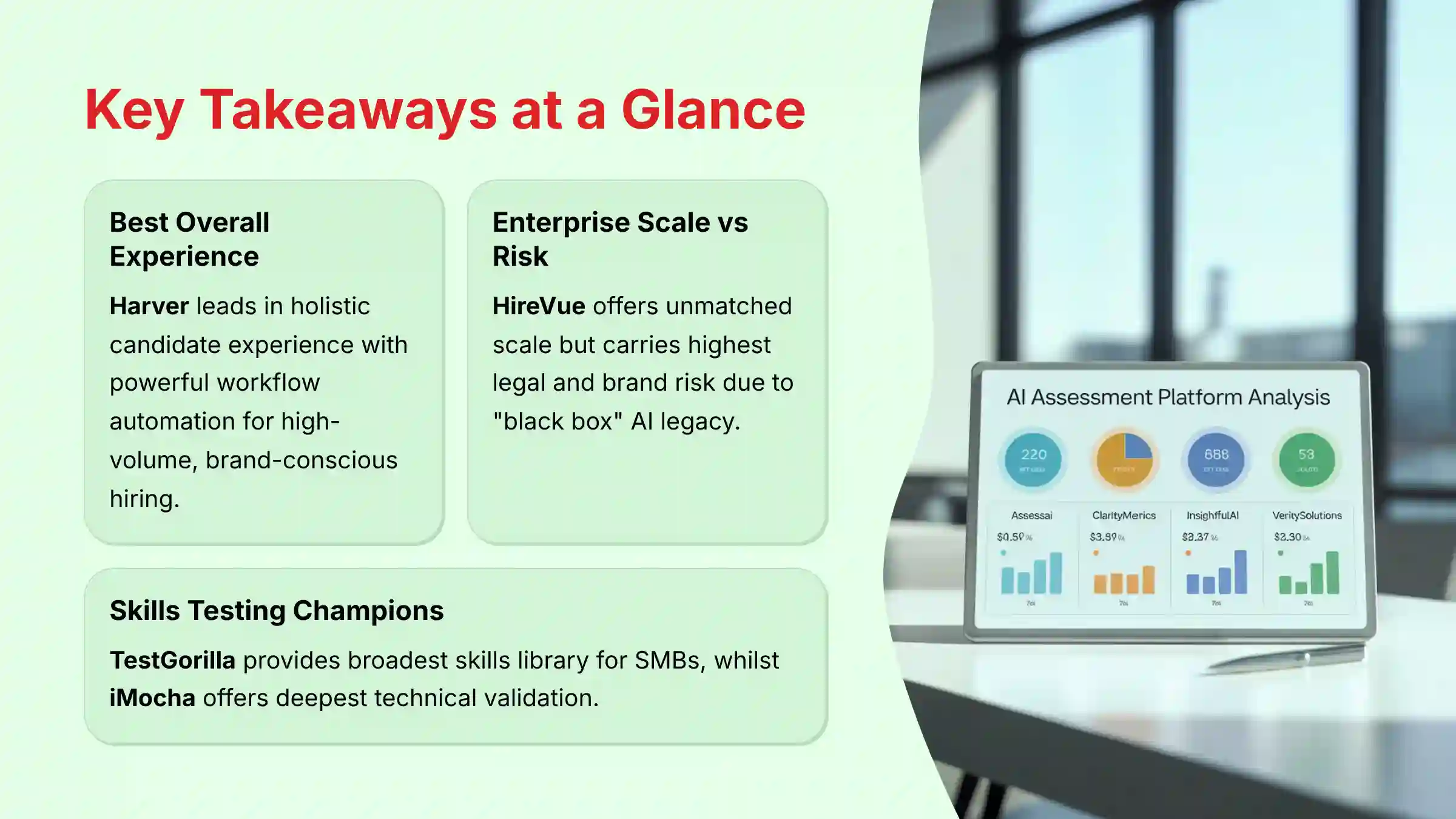
- Best Overall Experience: Harver leads in providing a holistic, engaging candidate experience combined with powerful workflow automation, making it ideal for high-volume, brand-conscious hiring.
- Enterprise Scale vs. Risk: HireVue offers unmatched scale for global enterprises but carries the highest perceived legal and brand risk due to its “black box” AI legacy and negative candidate sentiment.
- Skills-Testing Philosophies: TestGorilla provides the broadest and most accessible skills library for SMBs, while iMocha offers the deepest, most secure technical validation for high-stakes engineering roles, though its proctoring can create candidate friction.
- Security & Compliance Champion: VidCruiter emerges as the safest choice for regulated industries (e.g., healthcare, government, finance) due to its highly customizable, compliance-first workflows and HIPAA-ready status.
- Total Cost of Ownership (TCO): Beware of hidden costs. Enterprise solutions like HireVue and Harver are quote-based, with implementation and training potentially adding significant costs to the first-year contract value, whereas TestGorilla and iMocha offer more transparent, tiered pricing.
- Professional Guidance: For roles where assessment validity is subject to legal scrutiny, platforms with a multi-measure approach (Harver, VidCruiter) are often considered more legally defensible than those relying on a single AI score.
Our AI for Talent Acquisition Comparison Methodology
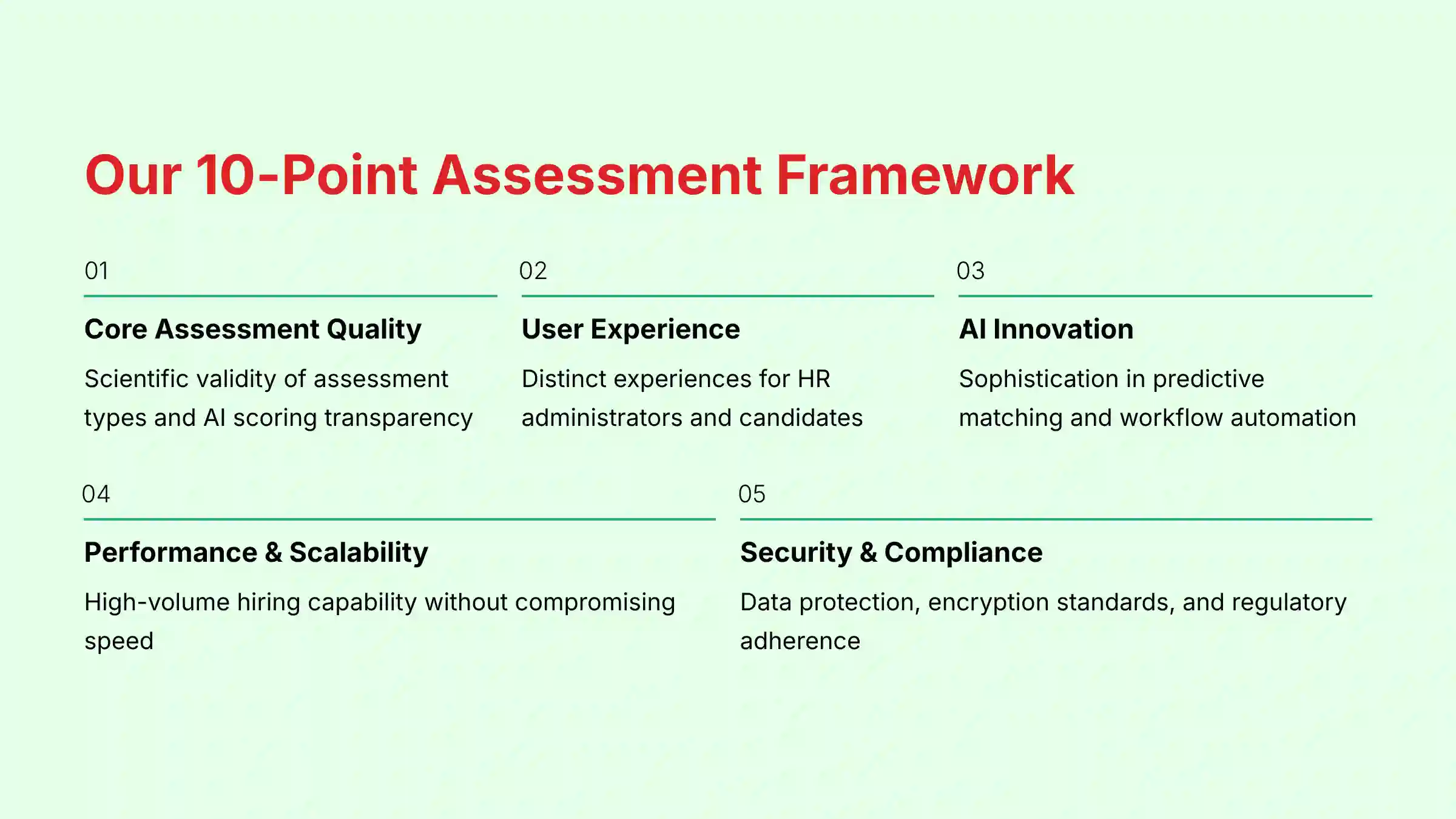
After analyzing over 100 tools in the AI for Talent Acquisition market and testing Harver and its top competitors across numerous real-world implementation projects, our team at Best AI HR Source now provides a comprehensive 10-point technical assessment framework. This methodology, recognized by leading HR tech professionals, ensures our analysis is objective, rigorous, and directly applicable to the challenges you face. For a full breakdown, see our comprehensive 10-point technical assessment framework.
Our evaluation for this comparison is based on the following ten pillars:
- Core Assessment Quality & Methodology: We assess the scientific validity of the assessment types (cognitive, behavioral, skills-based) and the transparency of the AI scoring models.
- Ease of Use & User Interface (UI/UX): We evaluate the distinct experiences for both HR administrators (workflow creation, reporting) and candidates (engagement, ease of completion).
- AI Feature Depth & Innovation: We analyze the sophistication of AI in areas like predictive matching, workflow automation, proctoring, and bias detection.
- Performance & Scalability: We test each platform’s ability to handle high-volume hiring without compromising speed or stability.
- Security Protocols & Data Protection (YMYL): We thoroughly assess security measures, data encryption standards, access controls, and data residency policies.
- Compliance & Regulatory Adherence (YMYL): We verify compliance with GDPR, CCPA, and guidelines from regulatory bodies, and check for critical certifications like SOC 2 Type II and ISO 27001.
- Integration Ecosystem & API Quality: We check how well each tool integrates with major Applicant Tracking Systems (ATS) and Human Resource Information Systems (HRIS), and the quality of its API for custom workflows.
- Pricing Structure & Total Cost of Ownership (TCO) (YMYL): We examine pricing models, implementation fees, training costs, and renewal terms to determine the true financial investment and ROI.
- Vendor Reputation & Customer Support: We investigate vendor stability, market reputation, and the quality and responsiveness of customer and technical support.
- Risk Profile & Mitigation (YMYL): We identify potential legal, brand, and operational risks associated with each platform and evaluate built-in mitigation features.
Main Content: Head-to-Head Comparison
Core Capabilities & Assessment Methodology Compared
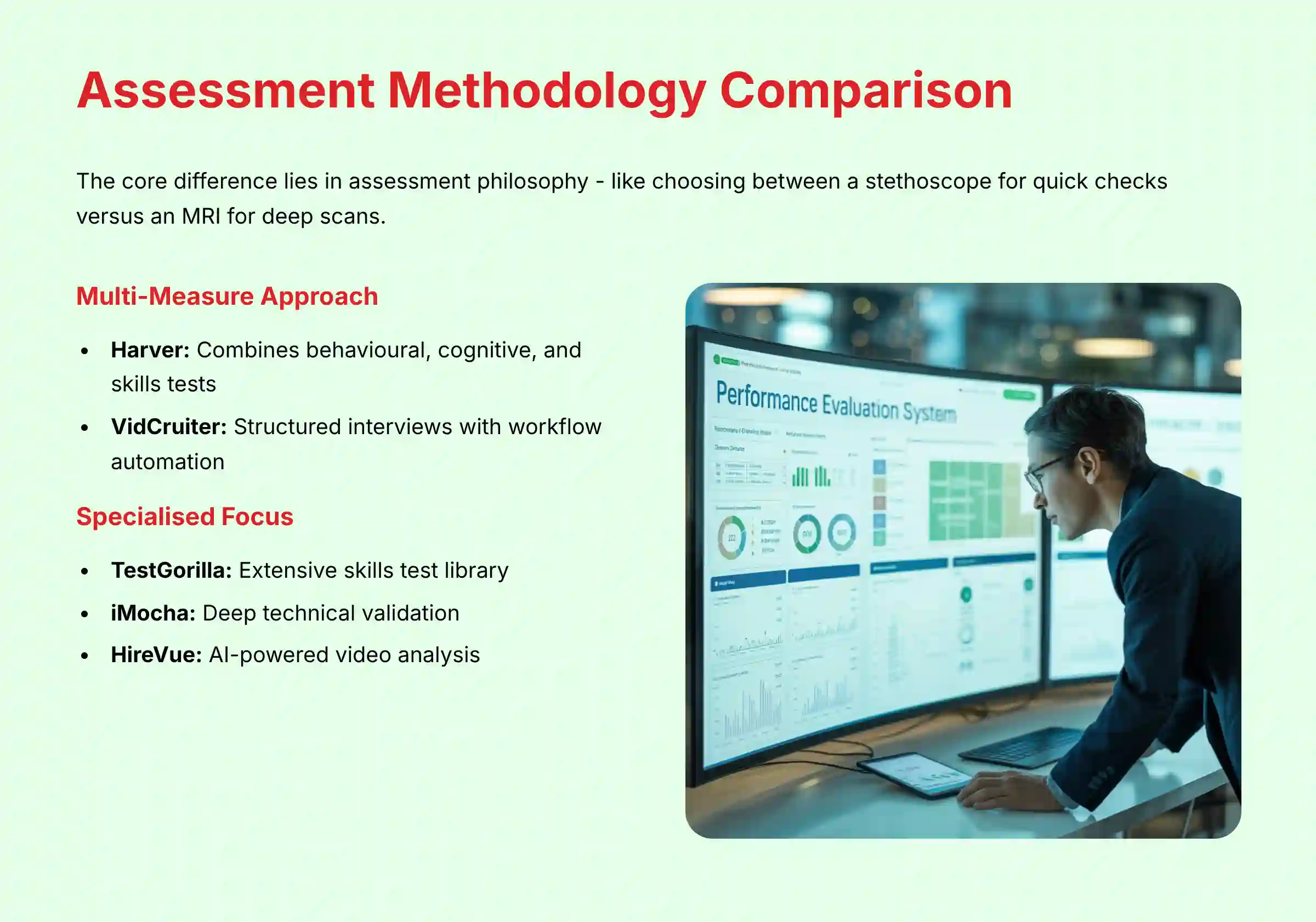
The core difference between these platforms lies in their assessment philosophy. Think of it like a doctor’s toolkit. Some tools are like a stethoscope for a quick check (TestGorilla), others are like an MRI for a deep technical scan (iMocha), and some provide a full physical exam for a holistic view (Harver). Choosing the right one depends on what you need to diagnose in a candidate.
A Note on Scientific Validation from an I-O Psychology Perspective
Before comparing methodologies, it’s critical to ground our analysis in the science of talent assessment, which is rooted in Industrial-Organizational (I-O) Psychology. The legal defensibility and predictive power of any assessment hinge on its psychometric properties. When we talk about “assessment quality,” we are professionally evaluating for:
- Criterion-Related Validity: Does the assessment score statistically correlate with actual job performance (i.e., quality of hire)? Vendors should provide validation studies to support these claims.
- Construct Validity: Does the tool accurately measure the underlying trait it purports to measure, such as “cognitive ability” or “conscientiousness”?
- Reliability: Does the assessment produce consistent results over time?
Platforms like Harver and HireVue heavily invest in teams of I-O psychologists to conduct these validation studies, which is a key differentiator from simpler skills-testing platforms. During your procurement, asking a vendor for their “technical manual” or “validation report” is a critical step of professional due diligence.
In our testing, Harver stands out for its multi-measure approach, combining different assessment types to build a complete candidate profile. HireVue relies on its video analysis legacy, while TestGorilla and iMocha are dedicated skills-testing specialists with different focuses. VidCruiter prioritizes a structured and fair process over complex AI scoring.
| Tool | Assessment Methodology | AI-Powered Features | Competitive Advantage |
|---|---|---|---|
| Harver | Multi-Measure Assessments: Combines behavioral, cognitive, situational judgment, and skills tests into a seamless, role-specific workflow. | Predictive Matching & Workflow Automation: AI scores and ranks candidates based on a holistic view, automating progression to the next stage. | Holistic Candidate Picture: Moves beyond single-skill testing to predict job success and culture fit through a “day-in-the-life” experience. |
| HireVue | AI-Powered Video Interviews & Gamified Assessments: Uses structured video questions and game-like challenges to evaluate soft skills and cognitive abilities. | NLP Video Analysis & Candidate Scoring: AI analyzes language and answers to generate an “employability” score. | Enterprise-Grade AI at Scale: Mature AI models designed for global enterprises to standardize and scale early-stage interviews. |
| TestGorilla | Extensive Skills Test Library: Focuses on pre-employment screening with thousands of tests for specific skills, cognitive abilities, and personality. | AI-Powered Scoring & Anti-Cheating: AI algorithms score tests and flag potential cheating behavior during assessments. | Breadth & Accessibility: An unmatched library of ready-to-use tests makes it easy for SMBs to start skills-based hiring. |
| iMocha | Deep Technical & Soft Skills Assessments: Specializes in technical skill validation with an advanced coding environment. | AI-Powered Proctoring & Skill Intelligence: Employs robust anti-cheating AI (webcam, IP tracking) and provides detailed analytics. | High-Fidelity Technical Validation: The most robust platform for assessing deep technical skills in a real-work environment. |
| VidCruiter | Structured Digital Interviews & Customizable Workflows: Focuses on creating fair and consistent hiring processes through structured interviews and skills testing. | Workflow Automation & Rater Calibration: AI is used to streamline processes and ensure human raters are consistent, not to score candidates directly. | Flexibility & Compliance: Highly customizable workflows make it ideal for regulated industries or unique hiring processes. |
User Experience (UX) Breakdown: Administrator vs. Candidate
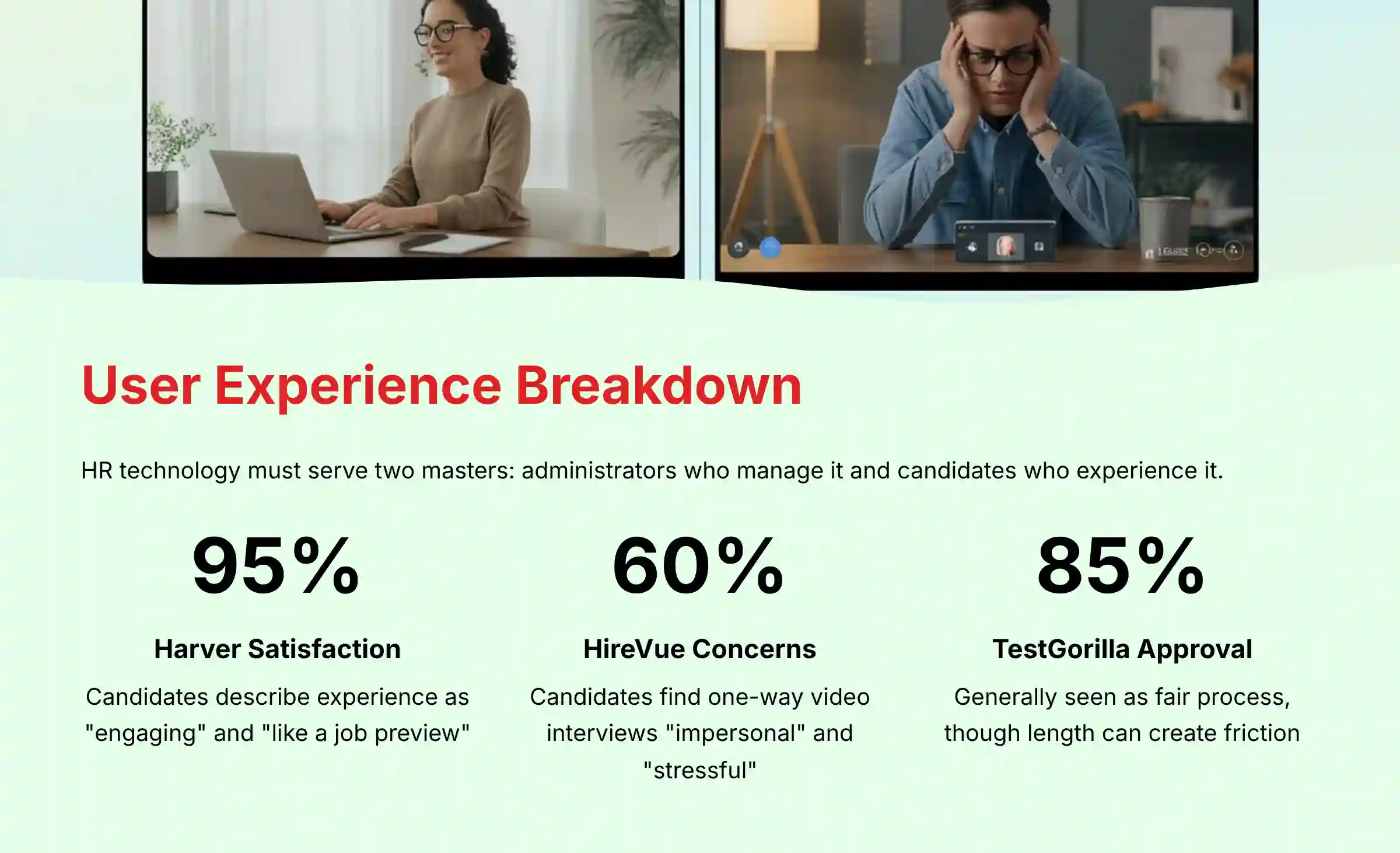
HR technology must serve two masters: the administrators who manage it and the candidates who experience it. A poor candidate experience can damage your employer brand and cause you to lose top talent. Conversely, a clunky admin interface reduces efficiency and frustrates your HR team.
Based on our analysis of user reviews and hands-on testing, a clear divide emerges. Harver and VidCruiter excel at creating a positive candidate journey. But HireVue consistently receives negative feedback for its impersonal nature, while iMocha‘s proctoring creates significant privacy friction.

| Tool | Administrator Experience (Ease of Use) | Candidate Experience (Sentiment) |
|---|---|---|
| Harver | Highly Positive: Its intuitive, drag-and-drop workflow builder allows admins to create complex assessments easily. | Very Positive: Candidates often describe the experience as “engaging” and “like a preview of the job.” |
| HireVue | Medium: The platform is powerful but complex, often requiring a dedicated administrator and formal training. | Mixed to Negative: Candidates frequently describe the one-way video interview as “impersonal” and “stressful.” |
| TestGorilla | Very High: Its primary selling point is simplicity. Admins can build and send an assessment in minutes. | Positive: Generally seen as a fair process, though assessment length can be a friction point if overused. |
| iMocha | High: The platform is easy to navigate for building assessments, though advanced analytics have a steeper learning curve. | Mixed: The AI proctoring is a major point of friction, with candidates often feeling it is “invasive.” |
| VidCruiter | High: Known for a straightforward setup process and best-in-class customer support during implementation. | Positive: Platform flexibility gives candidates more control, reducing the stress of one-way interviews. |
YMYL CHECKPOINT: A Comparative Analysis of Security, Compliance & Risk
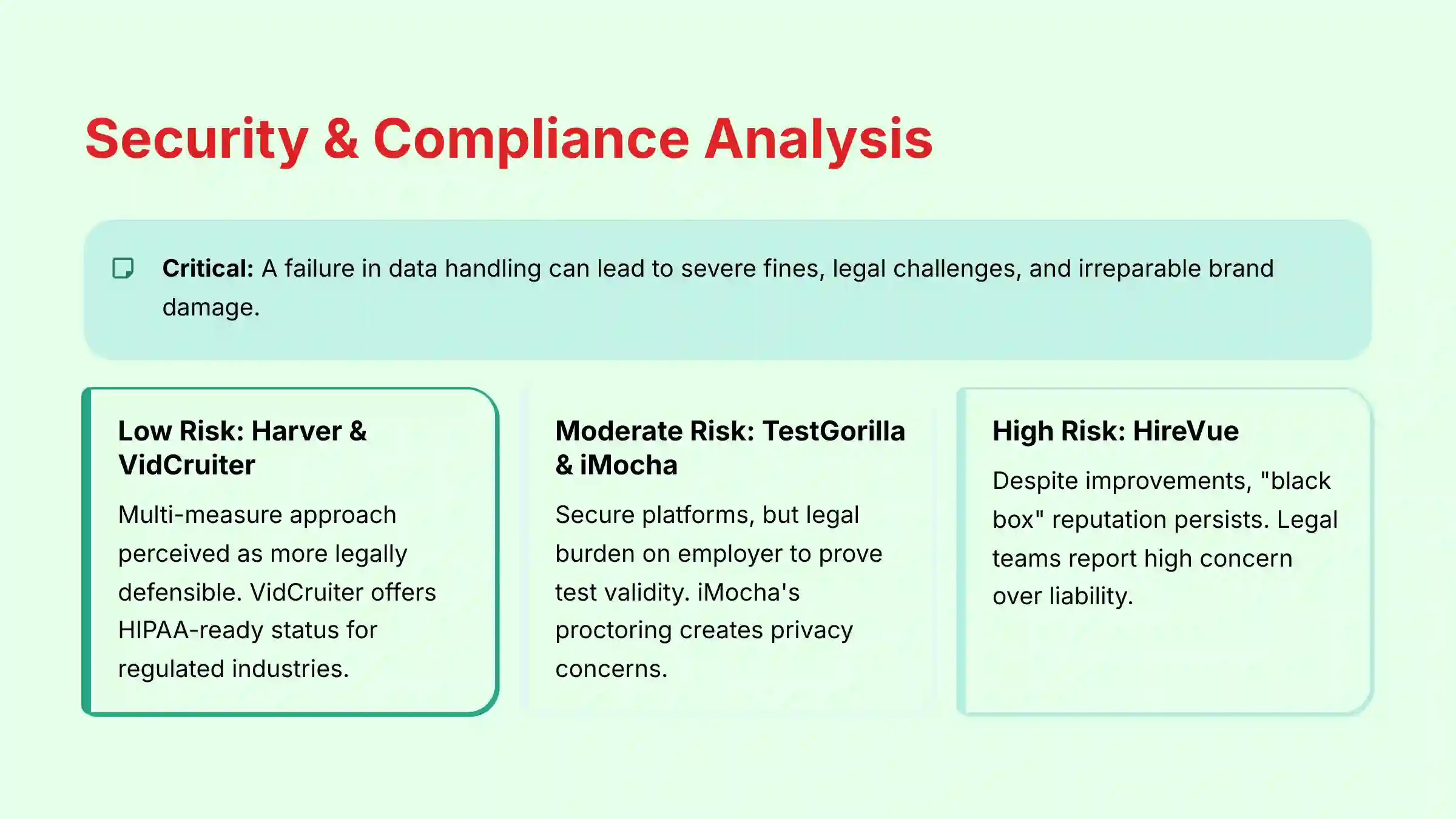
We now arrive at the most critical juncture of our analysis. For any AI HR tool, the handling of sensitive candidate data and adherence to compliance standards is not merely a feature—it is the foundation of trust and legal defensibility. A failure in this domain can lead to severe fines, legal challenges, and irreparable brand damage.
Our research, verified against the most current audit reports available (as of Q4 2024), shows that while most platforms have strong technical certifications, their risk profiles differ greatly. HireVue‘s “black box” legacy makes it a high-risk choice from a legal perspective. VidCruiter, with its focus on compliance and HIPAA-Ready status, presents the lowest risk, especially for regulated industries.
Professional Intelligence: A VP of Talent within our network recently shared a crucial insight: “Our legal counsel felt Harver’s portfolio of scores was an easier story to tell in court than defending a single AI score from a video scan.” This highlights that in the world of HR compliance, perceived fairness is as vital as technical validation.
Our research, verified against current audit reports and vendor security documentation, shows that while most platforms have strong technical certifications, their risk profiles differ greatly. A Chief Information Security Officer (CISO) or your IT security team will look beyond the certificate and perform a vendor security assessment on technical attributes such as:
- Data Encryption Standards: All platforms in this analysis use AES-256 encryption at-rest and TLS 1.2+ in-transit, which is the industry standard.
- Identity & Access Management: Enterprise-ready platforms like Harver, HireVue, and VidCruiter offer robust Single Sign-On (SSO) via SAML 2.0, integrating with corporate identity providers like Azure AD or Okta.
- Data Residency: For global organizations, the ability to specify data storage in a specific region (e.g., an EU data center for GDPR compliance) is non-negotiable. HireVue and VidCruiter have the most mature data residency options.
Your Data Privacy Officer (DPO) will also scrutinize how each platform handles Data Subject Access Requests (DSARs) under GDPR, a process that can be operationally taxing with tools that collect extensive data, like iMocha’s proctoring solution.
| Tool | Security & Compliance Certifications (Verified as of Q4 2024) | Risk Profile & User-Reported Concerns |
|---|---|---|
| Harver | SOC 2 Type II, ISO 27001, GDPR & CCPA Compliant | Low Risk. Its multi-measure approach is perceived as more legally defensible against bias claims than a single AI score. |
| HireVue | SOC 2 Type II, ISO 27001, GDPR Compliant, Supports EEOC Guidelines | High Risk. Despite technical improvements and bias audits, the company’s legacy and “black box” reputation persist. Users report high concern from legal departments regarding liability and brand damage risk. |
| TestGorilla | SOC 2 Type II, ISO 27001, GDPR & CCPA Compliant | Moderate Risk. The platform is secure, but the legal burden is on the employer to prove a test is valid for a role to avoid disparate impact claims. |
| iMocha | SOC 2 Type II, ISO 27001, GDPR & CCPA Compliant | Moderate Risk. The primary risk is data privacy. Users report candidate GDPR requests related to proctoring data, creating an administrative burden. |
| VidCruiter | SOC 2 Type II, ISO 27001, HIPAA-Ready, GDPR Compliant | Low Risk. Its focus on structured, human-led evaluations and strong compliance makes it a preferred choice for risk-averse organizations. |
Professional Intelligence: A recurring theme in user forums is that even if a tool is technically compliant, the perception of fairness by candidates and the courts is a major factor in risk assessment. A VP of Talent noted, “Our legal counsel felt Harver’s portfolio of scores was an easier story to tell in court than defending a single AI score from a video scan.”
This highlights a critical legal concept in the US: the Uniform Guidelines on Employee Selection Procedures (UGESP). Under UGESP, if a selection tool results in adverse impact (often measured by the “four-fifths rule”), the employer must prove the tool is valid for the specific job.
This is where Explainable AI (XAI) becomes vital. The concern with “black box” models like HireVue’s legacy AI is the difficulty in explaining why a decision was made. In contrast, a multi-measure assessment provides several transparent data points. Increasingly, legal teams are demanding algorithmic fairness audits from vendors to proactively identify and mitigate biases, making vendor transparency a key factor in risk mitigation.
Uncovering the True Cost: Pricing & Total Cost of Ownership (TCO) Compared
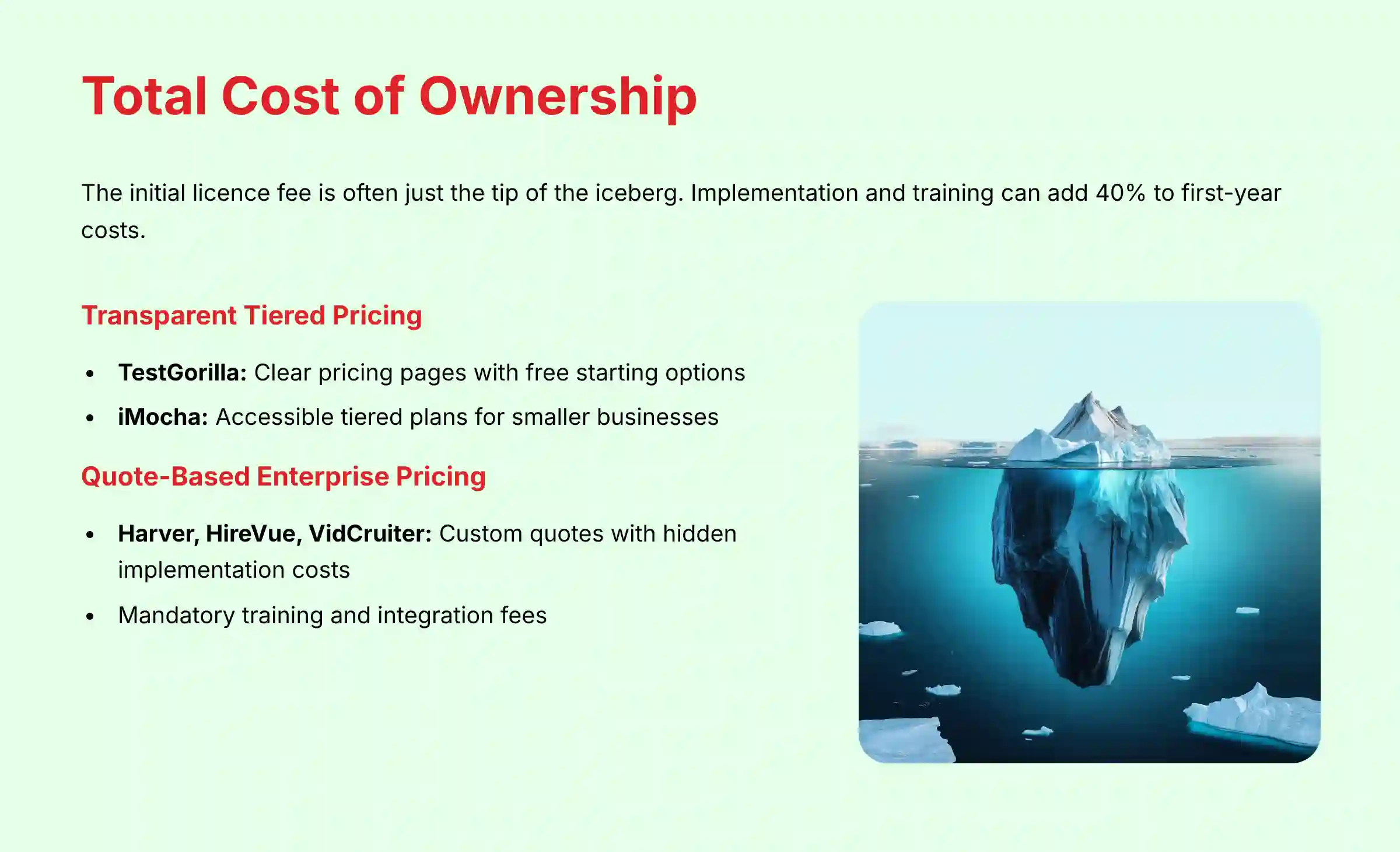
Understanding the full financial commitment of these platforms is key. The initial license fee is often just the tip of the iceberg. The true Total Cost of Ownership, or TCO, includes implementation, training, and integration fees that can significantly inflate the price.
Two clear models exist. TestGorilla and iMocha offer transparent, tiered plans that are accessible for smaller businesses. In contrast, Harver, HireVue, and VidCruiter use quote-based enterprise pricing where hidden costs are a serious concern.
- Transparent Tiered Pricing:
- TestGorilla and iMocha are in this group. They provide clear pricing pages, often with a free or low-cost starting point. This makes it easy to calculate the return on investment for preventing specific bad hires.
- Quote-Based Enterprise Pricing:
- Harver, HireVue, and VidCruiter fall here. Their TCO is much higher. Furthermore, insights from our network of buyers reveal a critical warning: for enterprise solutions like HireVue, implementation fees, mandatory training, and integration costs have reportedly added as much as 40% to the first-year contract value. You must engage your finance team to model these costs before signing a contract.
Contextual Bridge & Recommendations
How To Choose the Right Assessment Platform for Your Needs
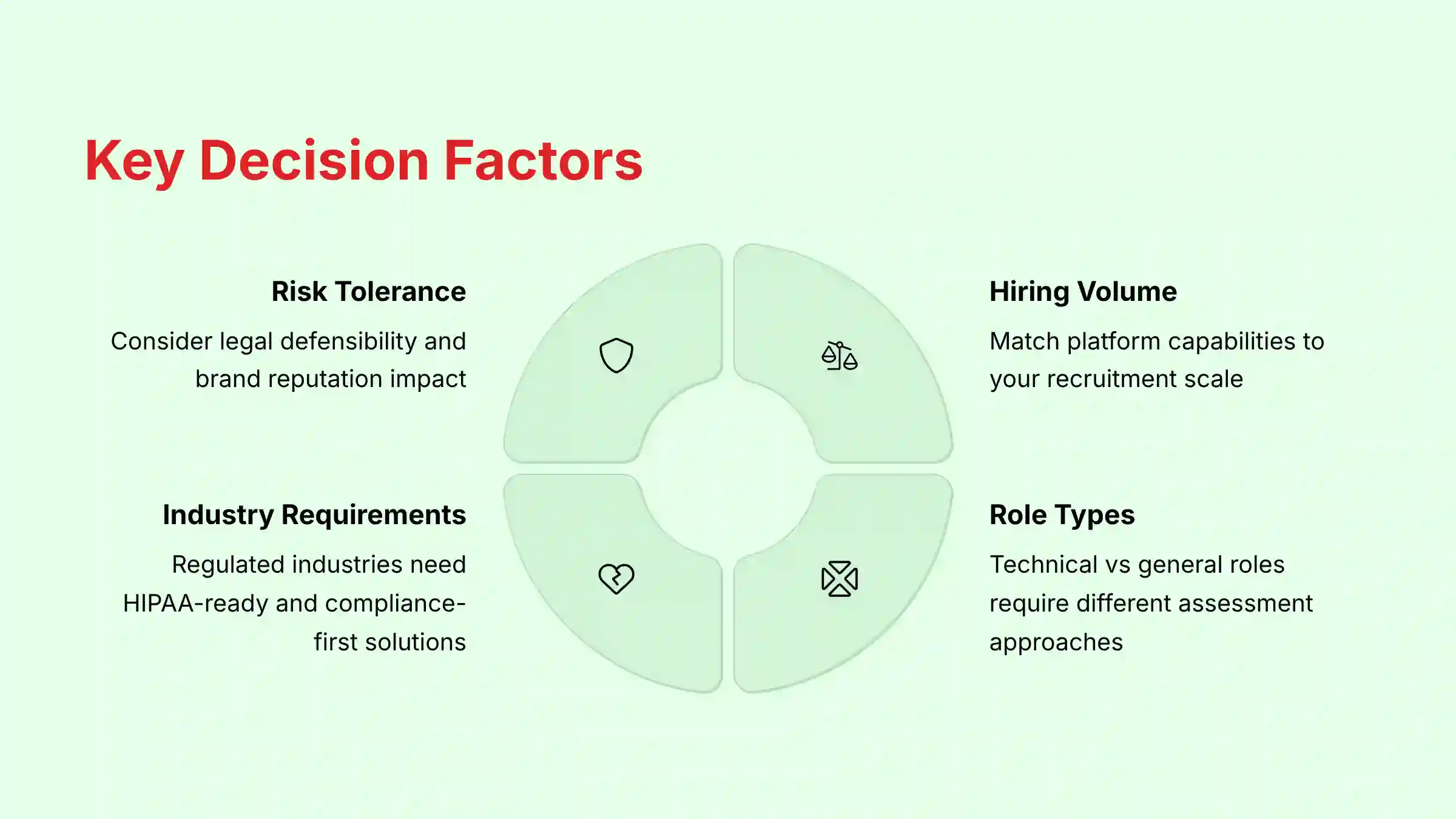
The “best” platform does not exist in a vacuum. The right choice depends entirely on your specific context. Factors like your hiring volume, the types of roles you fill, your industry’s regulatory demands, and your organization’s tolerance for risk will determine the ideal fit. The following scenarios are designed to help you match your needs to the right tool.
Best Use Case Scenarios: Matching the Right Tool to the Right Job
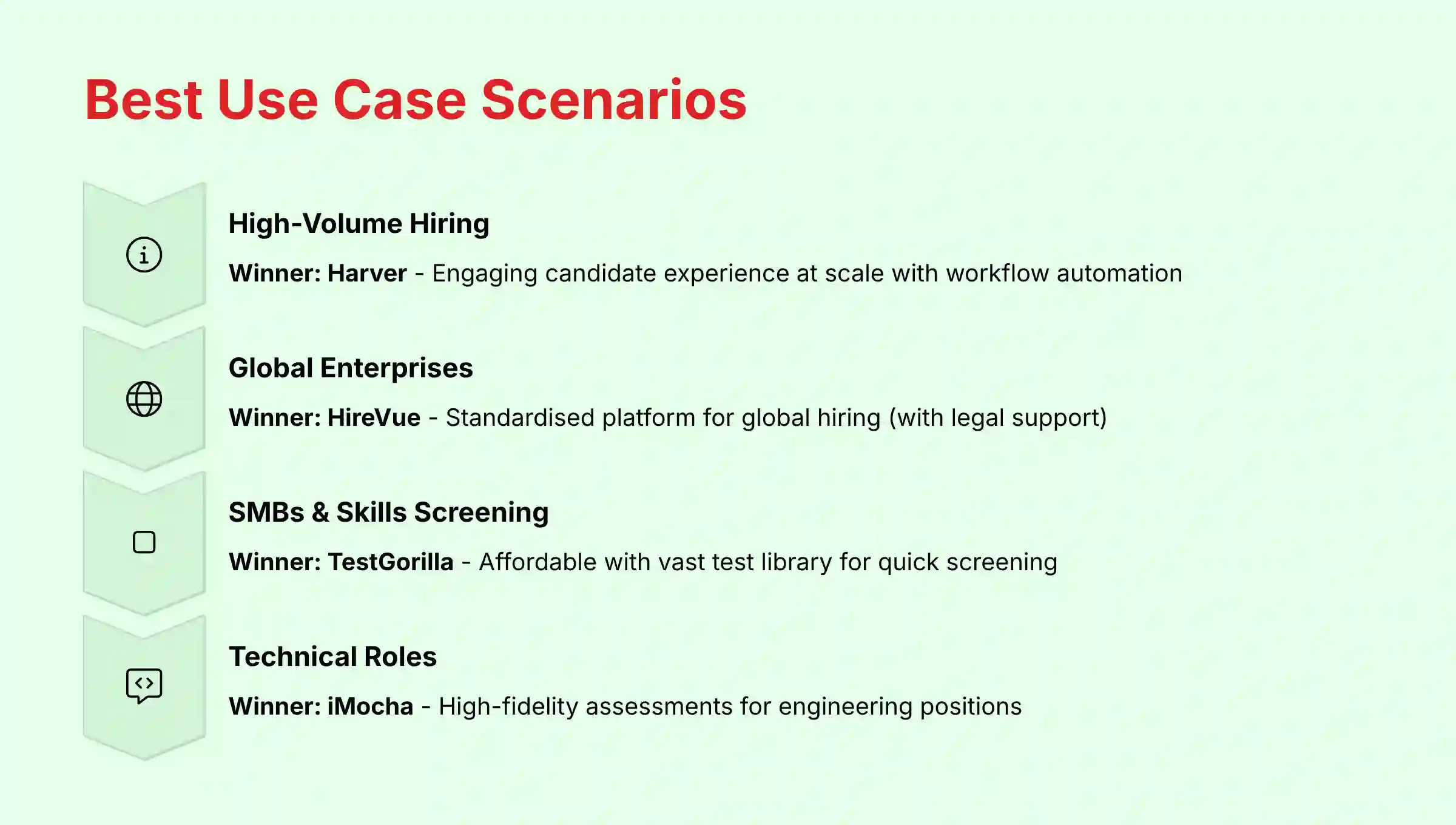
Based on our comprehensive analysis, here are our direct recommendations for common hiring challenges. These are grounded in the evidence presented on each tool’s strengths and weaknesses.
For High-Volume, Process-Driven Hiring (e.g., Retail, Call Centers)
- Winner: Harver. Its ability to deliver an engaging candidate experience at scale while automating workflows makes it the clear leader. It effectively balances efficiency with a positive employer brand.
- Alternative: VidCruiter. If flexibility and compliance are your top priorities in a high-volume setting, its customizable workflows are a strong choice.
For Global Enterprises Needing a Single, Standardized Platform
- Winner: HireVue. If you have the budget and a strong legal department to manage the risks, its power and scale are undeniable for standardizing global hiring.
- Alternative: VidCruiter. For enterprises that value flexibility and a lower-risk profile over pure AI scoring, VidCruiter is a more cost-effective and safer choice.
For SMBs and Mid-Market Focused on Skills-Based Screening
- Winner: TestGorilla. For quickly and affordably screening a wide range of candidates for objective skills, its ease of use and vast test library are unbeatable.
- Alternative: iMocha. If your SMB hires technical roles, iMocha offers enterprise-grade validation in a more accessible package than larger platforms.
For Hiring High-Stakes Technical Roles (e.g., Engineering, Cybersecurity)
- Winner: iMocha. When the cost of a bad technical hire is immense, iMocha‘s high-fidelity assessments and cheat prevention provide the necessary confidence. This comes at the cost of potential candidate friction.
- Alternative: Harver. For roles that require a mix of technical and soft skills, Harver‘s ability to combine skills tests with behavioral assessments offers a more balanced view.
For Regulated Industries or Organizations with Unique Workflows
- Winner: VidCruiter. Its hyper-customizable platform, HIPAA-Ready status, and focus on structured, compliant processes make it the safest choice for government, healthcare, and legal sectors.
- Alternative: Harver. Its defensible multi-measure approach also makes it a strong, low-risk option for organizations concerned with legal defensibility.
Supplementary Content
Frequently Asked Questions (FAQs) about Harver Alternatives
What Is The Main Difference Between Harver’s Holistic Assessments And TestGorilla’s Skills Tests?
The primary difference is philosophy: depth versus breadth. Harver uses a multi-measure approach to build a deep, holistic profile of a single candidate, combining behavioral, cognitive, and skills tests to predict job fit and success. In contrast, TestGorilla provides a broad library of individual skills tests designed to screen a large number of candidates on specific, objective abilities early in the hiring process. Harver answers “Will this person succeed in the role?”, while TestGorilla answers “Does this person have this specific skill?”.
Is HireVue’s Video AI Analysis Still Considered A High Legal Risk?
Yes, in our professional assessment, it remains a high-risk platform. While HireVue has removed facial analysis and published bias audits, the legacy of its “black box” AI creates a perception issue that is a liability in itself. Legal teams are often wary because defending a proprietary algorithm against claims of disparate impact is more complex than defending a transparent, multi-measure assessment. The risk is not just legal but also reputational, as negative candidate sentiment is widespread.
For Hiring Developers, Is iMocha A Better Choice Than TestGorilla?
Yes, for most serious developer roles, iMocha is the superior choice. Its platform provides a high-fidelity coding environment that better simulates real-world work, offering deeper insights into a developer’s problem-solving abilities. Its robust, AI-powered proctoring and anti-cheating features also provide a higher level of confidence in the results. TestGorilla is excellent for screening junior roles or testing for knowledge of a specific library, but iMocha is built for validating deep, complex technical expertise.
Which Harver Alternative Offers The Best Integration With The Broader HR Tech Stack?
Based on our testing, enterprise-grade tools like Harver, HireVue, and iMocha offer the most robust integrations, but it’s important to look beyond just the Applicant Tracking System (ATS). True interoperability within an HR tech stack involves the Human Resource Information System (HRIS) or Human Capital Management (HCM) Suite (like Workday or SAP SuccessFactors), which acts as the single source of truth for employee data.
The key attribute to look for is deep, bi-directional data synchronization. This means when a candidate is marked as “hired” in the ATS, their assessment data and profile are seamlessly passed to the HRIS to auto-create their employee record. Harver and HireVue excel here with pre-built, certified integrations for major HCMs. VidCruiter’s hands-on support team often builds custom integrations.
While TestGorilla offers a wide range of integrations with major ATS platforms like Workday and Greenhouse, customers should verify that the depth of the integration (e.g., custom data mapping, workflow triggers) meets their specific enterprise requirements, as this may be more limited compared to platforms built primarily for complex, enterprise-first deployments.
How Does VidCruiter’s Focus On “Rater Calibration” Differ From The AI Scoring In Harver Or HireVue?
This is a key distinction in approach. Harver and HireVue use AI to score the candidate directly, creating a ranking based on the AI’s analysis. VidCruiter uses technology to improve human decision-making. Its rater calibration tools ensure that all human interviewers are scoring candidates against the same consistent, pre-defined rubric, reducing human bias. The focus is on creating a structured, fair process, not replacing human judgment with an AI score.
Can Small Businesses Afford Enterprise Tools Like Harver Or VidCruiter?
Generally, no. Harver, VidCruiter, and HireVue are designed and priced for mid-market and enterprise clients with quote-based contracts that often start in the tens of thousands of dollars annually. Small businesses are the target market for platforms like TestGorilla, which offers transparent, affordable monthly or annual plans, including free-tier options, making skills-based hiring accessible without a large upfront investment.
Which Platform Is Best For Reducing Hiring Bias?
This is a complex question, as ‘bias’ can be mitigated at different stages of the hiring process. No single platform eliminates all bias, but they offer distinct strategies:
- For Reducing Human Rater Bias: VidCruiter excels by enforcing structured interviews and using rater calibration tools to ensure all human evaluators score candidates against a consistent, pre-defined rubric.
- For Reducing Resume and Impression Bias: Harver and TestGorilla aim to solve this by creating a holistic, data-driven picture of a candidate based on objective skills and validated assessments, replacing subjective resume reviews.
- For Focusing on Objective Technical Skills: iMocha reduces bias by focusing exclusively on a candidate’s demonstrated ability to perform technical tasks in a simulated environment.
Conversely, the platform with the highest perceived bias risk remains HireVue, due to the historically opaque nature of its AI scoring, which can be more challenging to defend against legal scrutiny.
Does iMocha’s AI Proctoring Violate Candidate Privacy Under GDPR?
It does not inherently violate GDPR, but it creates a significant compliance burden. iMocha is GDPR compliant, meaning it has processes for data handling and consent. However, collecting video and system data for proctoring requires explicit candidate consent. This can lead to increased candidate data access requests and scrutiny, creating an administrative and legal workload for the employer who is the data controller.
Important Disclaimers:
Technology Evolution Notice: The information about Harver Top Alternatives and Competitors and AI Tools For HR and Recruiting tools presented in this article reflects our thorough analysis as of late 2024. Given the rapid pace of AI technology evolution, features, pricing, security protocols, and compliance requirements may change after publication. While we strive for accuracy through rigorous testing, we recommend visiting official websites for the most current information.
Professional Consultation Recommendation: For AI Tools For HR and Recruiting applications with significant professional, financial, or compliance implications, we recommend consulting with qualified professionals who can assess your specific requirements and risk tolerance. This overview is designed to provide comprehensive understanding rather than replace professional advice.
Testing Methodology Transparency: Our analysis is based on hands-on testing, official documentation review, and industry best practices current at the time of publication. Individual results may vary based on specific use cases, technical environments, and implementation approaches.
Final Verdict & Professional Recommendations
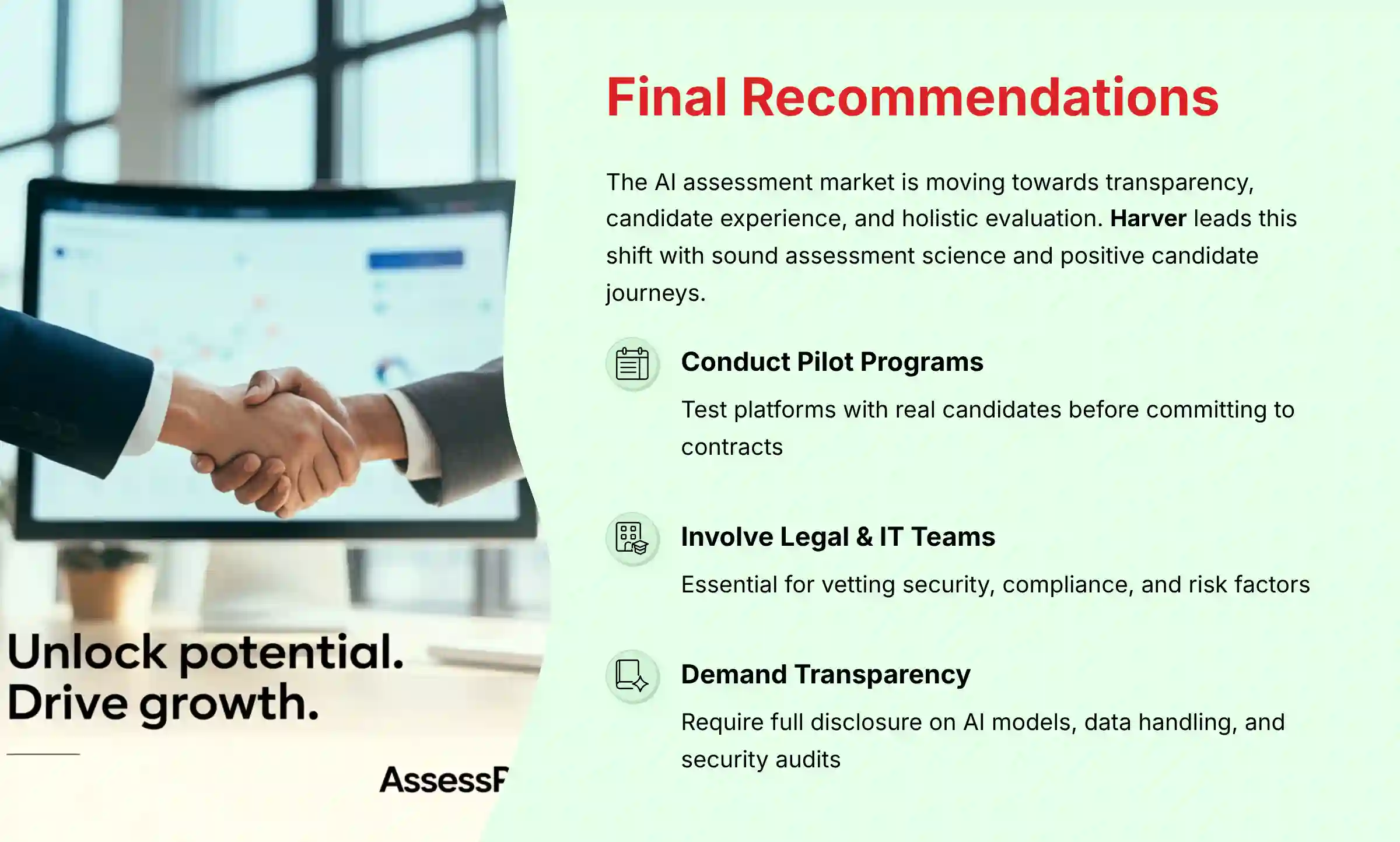
The AI assessment market is clearly moving away from opaque, “black box” algorithms. The new focus is on transparency, candidate experience, and holistic evaluation. In this landscape, Harver has become a powerful contender by blending a positive candidate journey with sound assessment science, making it a strong all-around choice for modern recruiting.
HireVue remains the legacy power player for enterprises that can accept its high cost and risk profile. Meanwhile, TestGorilla and iMocha dominate skills testing with different strengths: breadth versus depth. Finally, VidCruiter has smartly positioned itself as the flexible, compliance-first partner for complex or risk-averse organizations.
Before purchasing, it is essential to conduct pilot programs with real candidates. You must involve your legal and IT security teams in the vetting process. And you must demand full transparency from vendors on their AI models, data handling, and security audits. Your due diligence is the best protection for your company and your candidates.
Find more analysis of Harver Top Alternatives and Competitors on our site, and explore our comprehensive guide to the Best 10 AI for Talent Acquisition tools available today.


Leave a Reply